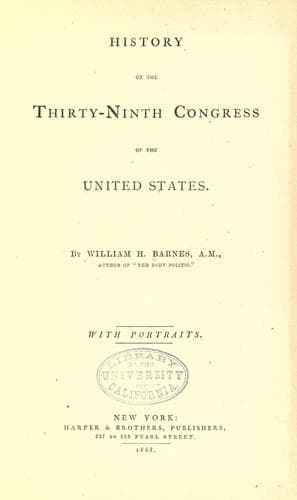
History of the Thirty-Ninth Congress of the United StatesBarnes, William Horatio
History
History of the Thirty-Ninth Congress of the United States
Barnes, William Horatio
United States -- Politics and government -- 1865-1869; United States. Congress (39th : 1865-1867)
"I would have been glad if he would have told us in what manner the
white men of this country would have been placed in a worse condition
than they are now, if this becomes the law. This general denunciation
and general assault of the bill, without pointing out one single thing
which is to deprive one single man of any right he enjoys under the
Government, seems to me not entitled to much weight.
"When those rights which are enumerated in this bill are denied to any
class of men, on account of race or color, when they are subject to a
system of vagrant laws which sells them into slavery or involuntary
servitude, which operates upon them as upon no other part of the
community, they are not secured in the rights of freedom. If a man can
be sold, the man is a slave. If he is nominally freed by the amendment
to the Constitution, he has nothing in the world he can call his own;
he has simply the labor of his hands on which he can depend. Any
combination of men in his neighborhood can prevent him from having any
chance to support himself by his labor. They can pass a law that a man
not supporting himself by labor shall be deemed a vagrant, and that a
vagrant shall be sold. If this is the freedom we gave the men who have
been fighting for us and in defense of the Government, if this is all
we have secured them, the President had far better never have issued
the Proclamation of Emancipation, and the country had far better never
have adopted the great ordinance of freedom.
"Does any man in this House believe that these people can be safely
left in these States without the aid of Federal legislation or
military power? Does any one believe that their freedom can be
preserved without this aid? If any man does so believe, he is
strangely blind to the history of the past year; strangely blind to
the enactments passed by Legislatures touching these freedmen. And I
shuddered as I heard the honorable gentleman from New Jersey [Mr.
Rogers] claiming that he was speaking and thinking in the spirit which
animated the Savior of mankind when he made atonement for our race;
that it was in that spirit he was acting when he was striving to have
these people left utterly defenseless in the hands of men who were
proving, day by day, month by month, that they desire to oppress them,
for they had been made free against their consent. Every act of
legislation, every expression of opinion on their part, proves that
these people would be again enslaved if they were not protected by the
military arm of the Federal Government; without that they would be
slaves to-day. And I submit, with all deference, that it is any thing
but the spirit which the gentleman claims to have exercised, which
prompted the argument he has made.
Public-domain text, read in full here on John Shaqi.
Reviews
Reviews
No reviews yet
Be the first to share your thoughts on this work.
Elsewhere in the archive
Join the Discussion
Join the discussion
Sign in to leave a comment or review.
Sign InorCreate an account