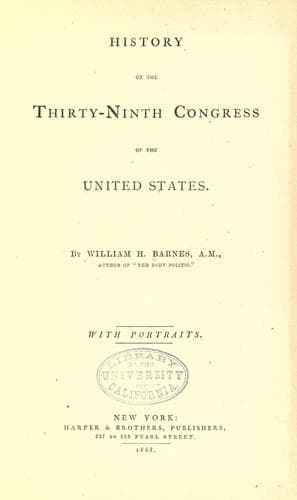
History of the Thirty-Ninth Congress of the United StatesBarnes, William Horatio
History
History of the Thirty-Ninth Congress of the United States
Barnes, William Horatio
United States -- Politics and government -- 1865-1869; United States. Congress (39th : 1865-1867)
"When the reports from Port Hudson and Fort Wagner thrilled all loyal
hearts by the recital of the heroic deeds of the black soldier, we
were not reminded that if the negro were permitted to enjoy the same
rights under the Government his valor helped to save that are
possessed by the perjured traitors who sought its destruction, it
would 'lead to a war of races.' O no! Then we were in peril, and felt
grateful even to the negro, who stood between us and our enemies. Then
our only hope of safety was in the brave hearts and strong arms of the
soldier at the front. Now, since by the combined efforts of our brave
soldiers, white and black, the military power of the South has been
overthrown, and her Representatives are as eager to resume their
places on this floor as five years ago they were to quit them for a
place in the rebel army, we are told that, having been victorious, it
becomes a great nation like ours to be magnanimous. I answer, it is
far more becoming to be just. I am willing to carry my magnanimity to
the verge of justice, but not one step beyond. I will go with him who
goes furthest in acts of generosity toward our former enemies, unless
those acts will be prejudicial to our friends. But when you advise me
to sacrifice those who have stood by us during the war, in order to
conciliate unrepentant rebels, whose hearts still burn with
ill-suppressed hatred to the Government, I scorn your counsel."
Mr. Shellabarger, of Ohio, said: "I agree with the gentleman on the
other side of the House, that this bill can not be passed under that
clause of the Constitution which provides that Congress may pass
uniform rules of naturalization. Under that clause it is my opinion
that the act of naturalization must not only be the act of the
Government, but also the act of the individual alien, by which he
renounces his former allegiance and accepts the new one. And that
proposition and distinction will be found, I think, in all judicious
arguments upon the subject.
"There is another class of persons well recognized, not only in our
constitutional history, but also by the laws of nations, who are not
foreigners, who occupy an intermediate position, and that intermediate
position is defined by the laws of nations by the word 'subjects.'
Subjects are all persons who, being born in a given country, and under
a given government, do not owe an allegiance to any other government.
"To that class in this country, according to the decisions of our
courts hitherto, belong American Indians and slaves, and, according to
the Dred Scott decision, persons of African descent whose ancestors
were slaves. All these were subjects by every principle of
international as well as of settled constitutional law in this
country.
Public-domain text, read in full here on John Shaqi.
Reviews
Reviews
No reviews yet
Be the first to share your thoughts on this work.
Elsewhere in the archive
Join the Discussion
Join the discussion
Sign in to leave a comment or review.
Sign InorCreate an account