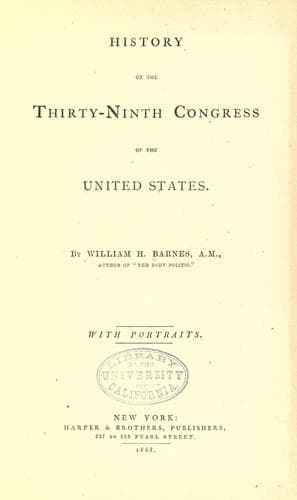
History of the Thirty-Ninth Congress of the United StatesBarnes, William Horatio
History
History of the Thirty-Ninth Congress of the United States
Barnes, William Horatio
United States -- Politics and government -- 1865-1869; United States. Congress (39th : 1865-1867)
"But, sir, there is another answer, in my judgment, more conclusive,
to all these objections to this second section, which is the vital
part of the bill. Without it, it would scarcely be worth the paper on
which the bill is written. A law without a penalty, without a
sanction, is of little value to any body. What good does it do for the
Legislature to say, 'Do this, and forbear to do that,' if no
consequence is to follow the act of disobedience? This is the vitality
of the bill. What is the objection that is made to it, and which seems
even to have staggered some friends of the measure? It is because it
reads in the first section that any person who, 'under color of law,'
shall commit these offenses, shall be subject to the penalties of the
law. Suppose those words had been left out, and the bill read, 'any
person who shall subject any inhabitant of a State to different
punishment by reason of his color shall be punished,' would there have
been any objection to the bill then? That is the way most criminal
laws read. That is the way the law punishing conspiracies against the
Government reads. If two or more persons conspire together to
overthrow the Government, or by force to resist its authority, they
are liable to indictment, and, upon conviction, to imprisonment in the
penitentiary and to heavy fine. Would the fact that the persons
engaged in the conspiracy were judges or governors or ministerial
officers, acting under color of any statute or custom, screen them
from punishment? Surely not.
"The words 'under color of law' were inserted as words of limitation,
and not for the purpose of punishing persons who would not have been
subject to punishment under the act if they had been omitted. If an
offense is committed against a colored person simply because he is
colored, in a State where the law affords him the same protection as
if he were white, this act neither has nor was intended to have any
thing to do with his case, because he has adequate remedies in the
State courts; but if he is discriminated against, under color of State
laws, because he is colored, then it becomes necessary to interfere
for his protection.
"The assumption that State judges and other officials are not to be
held responsible for violations of United States laws when done under
color of State statutes or customs is akin to the maxim of the English
law that the king can do no wrong. It places officials above the law;
it is the very doctrine out of which the rebellion was hatched.
Public-domain text, read in full here on John Shaqi.
Reviews
Reviews
No reviews yet
Be the first to share your thoughts on this work.
Elsewhere in the archive
Join the Discussion
Join the discussion
Sign in to leave a comment or review.
Sign InorCreate an account