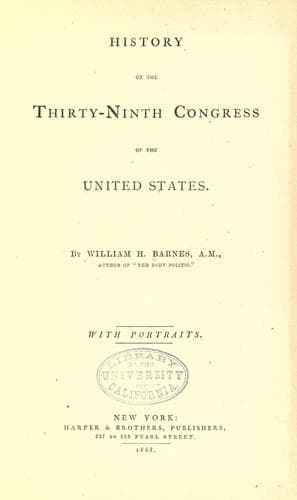
History of the Thirty-Ninth Congress of the United StatesBarnes, William Horatio
History
History of the Thirty-Ninth Congress of the United States
Barnes, William Horatio
United States -- Politics and government -- 1865-1869; United States. Congress (39th : 1865-1867)
NAYS--Messrs. Ancona, Bergen, Boyer, Coffroth, Dawson,
Dennison, Eldridge, Finck, Glossbrenner, Aaron Harding,
Harris, Hogan, Edwin N. Hubbell, James M. Humphrey, Latham,
Le Blond, Marshall, McCullough, Niblack, Nicholson, Noell,
Phelps, Radford, Samuel J. Randall, William H. Randall,
Raymond, Ritter, Rogers, Ross, Rosseau, Shanklin,
Sitgreaves, Smith, Strouse, Taber, Taylor, Thornton,
Trimble, Whaley, Winfield, and Wright--41.
NOT VOTING--Messrs. Ames, Anderson, Bingham, Blaine, Blow,
Chanler, Culver, Driggs, Dumont, Goodyear, Grider, Demas
Hubbard, Johnson, Jones, Julian, Kerr, Kuykendall, Sloan,
Stilwell, Warner, and Williams--21.
The Speaker then made the following announcement: "The yeas are 122,
and the nays 41. Two-thirds of the House having, upon this
reconsideration, agreed to the passage of the bill, and it being
certified officially that a similar majority of the Senate, in which
the bill originated, also agreed to its passage, I do, therefore, by
the authority of the Constitution of the United States, declare that
this bill, entitled 'An act to protect all persons in the United
States in their civil rights, and furnish the means of their
vindication,' has become a law."
This announcement was followed by prolonged applause on the floor of
the House and among the throng of spectators in the galleries.
The following is the form in which the great measure so long pending
became a law of the land:
"_Be it enacted by the Senate and House of Representatives
of the United States of America in Congress assembled_, That
all persons born in the United States and not subject to any
foreign Power, excluding Indians not taxed, are hereby
declared to be citizens of the United States; and such
citizens of every race and color, without regard to any
previous condition of slavery or involuntary servitude,
except as a punishment for crime whereof the party shall
have been duly convicted, shall have the same right in every
State and Territory in the United States to make and enforce
contracts, to sue, be parties, and give evidence, to
inherit, purchase, lease, sell, hold, and convey real and
personal property, and to full and equal benefit of all laws
and proceedings for the security of person and property as
is enjoyed by white citizens, and shall be subject to like
punishment, pains, and penalties, and to none other, any
law, statute, ordinance, regulation, or custom to the
contrary notwithstanding.
Public-domain text, read in full here on John Shaqi.
Reviews
Reviews
No reviews yet
Be the first to share your thoughts on this work.
Elsewhere in the archive
Join the Discussion
Join the discussion
Sign in to leave a comment or review.
Sign InorCreate an account