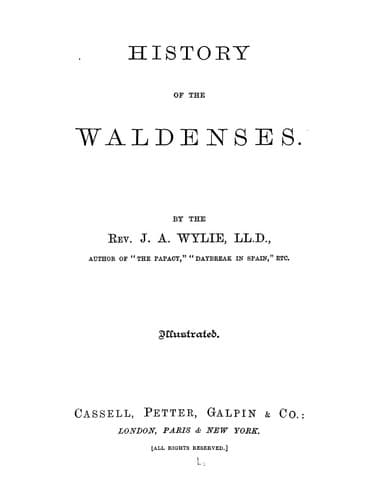
History of the WaldensesWylie, J. A. (James Aitken)
History
History of the Waldenses
Wylie, J. A. (James Aitken)
Church history -- Middle Ages, 600-1500; Waldenses
The century passed without any very noticeable event. The spiritual
condition of the Vaudois languished. The year 1789 brought with it
astounding changes. The French Revolution rung out the knell of the old
times, and introduced, amidst those earthquake-shocks that convulsed
nations, and laid thrones and altars prostrate, a new political age.
The Vaudois once again passed under the dominion of France. There
followed an enlargement of their civil rights, and an amelioration
of their social condition; but, unhappily, with the friendship of
France came the poison of its literature, and Voltairianism threatened
to inflict more deadly injury on the Church of the Alps than all
the persecutions of the previous centuries. At the Restoration
the Waldenses were given back to their former sovereign, and with
their return to the House of Savoy they returned to their ancient
restrictions, though the hand of bloody persecution could no more be
stretched out.
The time was now drawing near when this venerable people was to obtain
a final emancipation. That great deliverance rose on them, as day rises
on the earth, by slow stages. The visit paid them by the apostolic
Felix Neff, in 1808, was the first dawning of their new day. With him
a breath from heaven, it was felt, had passed over the dry bones. The
next stage in their resurrection was the visit of Dr. William Stephen
Gilly, in 1828. He cherished, he tells us, the conviction that “this
is the spot from which it is likely that the great Sower will again
cast his seed, when it shall please him to permit the pure Church of
Christ to resume her seat in those Italian States from which Pontifical
intrigues have dislodged her.”[147] The result of Dr. Gilly’s visit was
the erection of a college at La Torre, for the instruction of youth
and the training of ministers, and an hospital for the sick; besides
awakening great interest on their behalf in England.[148]
After Dr. Gilly there stood up another to befriend the Waldenses,
and prepare them for their coming day of deliverance. The career of
General Beckwith is invested with a romance not unlike that which
belongs to the life of Ignatius Loyola. Beckwith was a young soldier,
and as brave, and chivalrous, and ambitious of glory as Loyola. He had
passed unhurt through battle and siege. He fought at Waterloo till the
enemy was in full retreat, and the sun was going down. But a flying
soldier discharged his musket at a venture, and the leg of the young
officer was hopelessly shattered by the bullet. Beckwith, like Loyola,
passed months upon a bed of pain, during which he drew forth from his
portmanteau his neglected Bible, and began to read and study it. He had
lain down, like Loyola, a knight of the sword, and like him he rose up
a knight of the Cross, but in a truer sense.
Public-domain text, read in full here on John Shaqi.
Reviews
Reviews
No reviews yet
Be the first to share your thoughts on this work.
Elsewhere in the archive
Join the Discussion
Join the discussion
Sign in to leave a comment or review.
Sign InorCreate an account