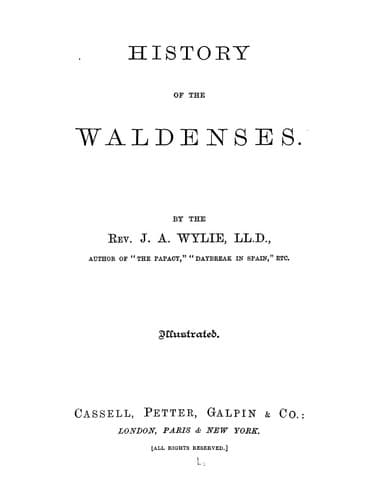
History of the WaldensesWylie, J. A. (James Aitken)
History
History of the Waldenses
Wylie, J. A. (James Aitken)
Church history -- Middle Ages, 600-1500; Waldenses
They were forbidden to evangelise or make converts. But though fettered
on the one side they were not equally protected on the other, for the
priests had full liberty to enter their Valleys, and proselytise;
and if a boy of twelve or a girl of ten professed willingness to
enter the Roman Church, they were to be taken from their parents,
that they might with the more freedom carry out their intention. They
could not marry save among their own people. They could not erect a
sanctuary save on the soil of their own territory. They could take
no degree at any of the colleges of Piedmont. In short, the duties,
rights, and privileges that constitute _life_ they were denied. They
were reduced as nearly as was practicable to simple existence, with
this one great exception--which was granted them not as a right, but
as a favour--namely, the liberty of Protestant worship within their
territorial limits.
The Revolution of 1848, with trumpet-peal, sounded the overthrow
of all these restrictions. They fell in one day. The final end of
Providence in preserving that people during long centuries of fearful
persecutions now began to be seen. The Waldensian Church became the
door by which freedom of conscience entered Italy. When the hour came
for framing a new constitution for Piedmont, it was found desirable
to give standing-room in that constitution to the Waldenses, and this
necessitated the introduction into the edict of the great principle of
freedom of worship as a right. The Waldenses had contended for that
principle for ages--they had maintained and vindicated it by their
sufferings and martyrdoms; and therefore they were necessitated to
demand, and the Piedmontese Government to grant, this great principle.
It was the only one of the many new constitutions framed for Italy
at that same time in which freedom of conscience was enacted. Nor
would it have found a place in the Piedmontese constitution, but for
the circumstance that here were the Waldenses, and that their great
distinctive principle demanded legal recognition, otherwise they would
remain outside the constitution. The Vaudois alone had fought the
battle, but all their countrymen shared with them the fruits of the
great victory. When the news of the Statuto of Carlo Alberto reached La
Torre there were greetings on the streets, psalms in the churches, and
blazing bonfires at night on the crest of the snowy Alps.
Public-domain text, read in full here on John Shaqi.
Reviews
Reviews
No reviews yet
Be the first to share your thoughts on this work.
Elsewhere in the archive
Join the Discussion
Join the discussion
Sign in to leave a comment or review.
Sign InorCreate an account