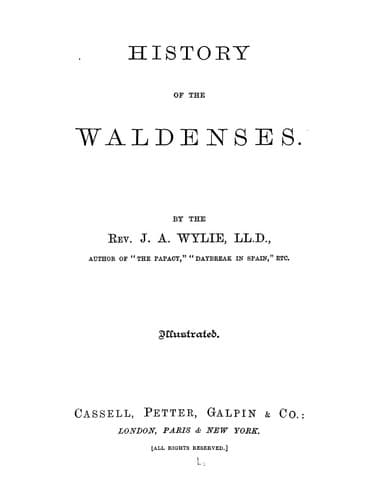
History of the WaldensesWylie, J. A. (James Aitken)
History
History of the Waldenses
Wylie, J. A. (James Aitken)
Church history -- Middle Ages, 600-1500; Waldenses
Part of the sum agreed upon between La Trinita and the Waldenses had
now been paid to him. To raise this money the poor people were under
the necessity of selling their herds. The count now withdrew his army
into winter quarters at Cavour, a point so near the Valleys that a few
hours’ march would enable him to re-enter them at any moment. The corn,
and oil, and wine he had not been able to carry away he destroyed. Even
the mills he broke in pieces. His design appeared to be to leave the
Vaudois only the alternative of submission, or of dying of hunger on
their mountains. To afflict them yet more, he placed garrisons here
and there in the Valleys; and, in the very wantonness of tyranny,
required those who were themselves without bread to provide food for
his soldiers. These soldiers were continually prowling about in search
of victims on whom to gratify their cruelty and their lust. Those who
had the unspeakable misfortune to be dragged into their den, had to
undergo, if men, excruciating torture; if women, revolting outrage.[65]
CHAPTER IX.
THE GREAT CAMPAIGN OF 1561.
Mass or Extermination--Covenant in the Valleys--Their
Solemn Oath--How the Waldenses Recant--Their Energetic
Preparations--La Trinita Advances his Army--Twice
attempts to Enter Angrogna, and is Repulsed--A Third
Attempt--Attacks on Three Points--Repulsed on all
Three--Ravages the Valley of Rora--Receives Reinforcements
from France and Spain--Commences a Third Campaign--Six Men
against an Army--Utter Discomfiture--Extinction of La
Trinita’s Host--Peace.
These frightful inflictions the Waldenses had submitted to, in the
hope that the deputies whom they had sent to the duke would bring
back with them an honourable peace. The impatience with which they
waited their return may well be conceived. At last, after an absence
of six weeks, the commissioners reappeared in the Valleys; but their
dejected faces, even before they had uttered a word, told that they
had not succeeded. They had been sent back with an order, enjoining
on the Vaudois unconditional submission to the church of Rome on
pain of extermination. To enforce that order to the uttermost a more
numerous army was at that moment being raised. The mass or universal
slaughter--such was the alternative now presented to them.
The spirit of the people woke up. Rather than thus disgrace their
ancestors, imperil their own souls, and entail a heritage of slavery
on their children, they would die a thousand times. Their depression
was gone; they were as men who had awakened from heavy sleep; they had
found their arms. Their first care was to recall their pastors, their
next to raise up their fallen churches, and their third to resume
public service in them. Daily their courage grew, and once more joy
lighted up their faces.
[Illustration: THE VAUDOIS TAKING THEIR OATH.]
Public-domain text, read in full here on John Shaqi.
Reviews
Reviews
No reviews yet
Be the first to share your thoughts on this work.
Elsewhere in the archive
Join the Discussion
Join the discussion
Sign in to leave a comment or review.
Sign InorCreate an account