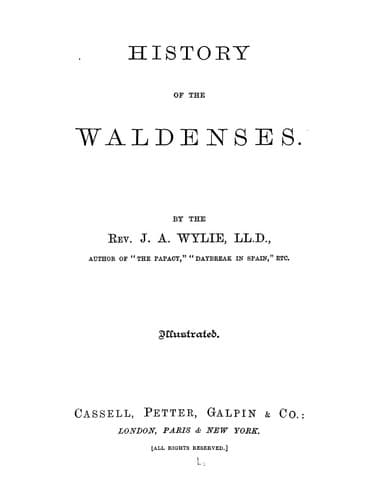
History of the WaldensesWylie, J. A. (James Aitken)
History
History of the Waldenses
Wylie, J. A. (James Aitken)
Church history -- Middle Ages, 600-1500; Waldenses
Standing upon the summit of the Janiculum Mount, vast crowds could
witness the spectacle. In front the Campagna spreads out its once
glorious but now desolated bosom; and winding through it like a thread
of gold is seen the Tiber, while the Apennines, sweeping round it in
craggy grandeur, enclose it like a vast wall. Immediately beneath,
uprearing her domes and monuments and palaces, with an air that seems
to say, “I sit a queen,” is the city of Rome. Yonder, asserting an
easy supremacy amid the other fabrics of the Eternal City, is the
scarred and riven yet Titanic form of the Coliseum, with its stains of
early Christian blood not yet washed out. By its side, the partner of
its guilt and doom, lies the Palatine, once the palace of the world’s
master, now a low mound of ruins, with its row of melancholy cypresses,
the only mourners on that site of vanished glory and fallen empire.
Nearer, burning in the midday sun, is the proud cupola of St. Peter’s,
flanked on the one side by the buildings of the Inquisition, and on the
other by the huge Mole of Hadrian, beneath whose gloomy ramparts old
Tiber rolls sluggishly and sullenly along. But what shout is this which
we hear? Why does Rome keep holiday? Why do all her bells ring? Lo!
from every street and piazza eager crowds rush forth, and uniting in
one overwhelming and surging stream, they are seen rolling across the
Bridge of St. Angelo, and pressing in at the gates of the old fortress,
which are thrown wide open to admit this mass of human beings.
Entering the court-yard of the old castle, an imposing sight meets
the eye. What a confluence of ranks, dignities, and grandeurs! In
the centre is placed a chair, the emblazonry of which tells us that
it claims to rise in authority and dignity over the throne of kings.
The Pontiff, Pius IV., has already taken his seat upon it, for he has
determined to be present at the tragedy of to-day. Behind his chair, in
scarlet robes, are his cardinals and counsellors, with many dignitaries
besides in mitres and cowls, ranged in circles, according to their
place in the Papal body. Behind the ecclesiastics are seated, row on
row, the nobility and beauty of Rome. Plumes wave, stars gleam, and
seem to mock the frocks and cowls gathered near them, whose wearers,
however, would not exchange these mystic garments for all the bravery
that blazes around them. The vast sweep of the Court of St. Angelo is
densely occupied. Its ample floor is covered from end to end with a
closely-wedged mass of citizens, who have come to see the spectacle.
In the centre of the throng, rising a little way over the sea of human
heads, is seen a scaffold, with an iron stake, and beside it a bundle
of faggots.
Public-domain text, read in full here on John Shaqi.
Reviews
Reviews
No reviews yet
Be the first to share your thoughts on this work.
Elsewhere in the archive
Join the Discussion
Join the discussion
Sign in to leave a comment or review.
Sign InorCreate an account