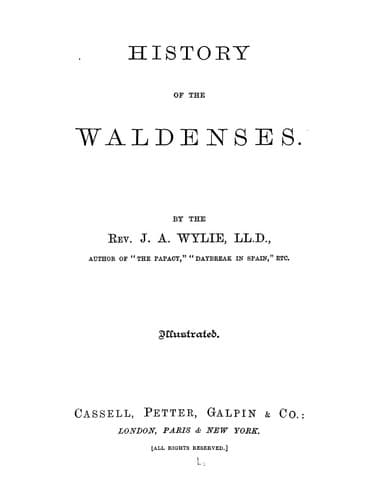
History of the WaldensesWylie, J. A. (James Aitken)
History
History of the Waldenses
Wylie, J. A. (James Aitken)
Church history -- Middle Ages, 600-1500; Waldenses
Guilt is ever cowardly. Pianeza now began to have misgivings touching
the issue. The recollection that mighty armies had aforetime perished
on these mountains haunted and disquieted him. He betook him to a
weapon which the Waldenses have ever been less able to cope with than
the sword. On Wednesday, the 21st, before daybreak, he announced, by
sound of trumpet at the various Vaudois entrenchments, his willingness
to receive their deputies and treat for peace. Delegates set out for
his camp, and on their arrival at head-quarters were received with
the utmost urbanity, and sumptuously entertained. Pianeza expressed
the utmost regret for the excesses his soldiers had committed, and
which had been done, he said, contrary to orders. He protested that
he had come into their valleys only to track a few fugitives who had
disobeyed Gastaldo’s order, that the higher communes had nothing to
fear, and that if they would admit a single regiment each for a few
days, in token of their loyalty, all would be amicably ended. The craft
of the man conquered the deputies, and despite the warnings of the
more sagacious, the pastor Leger in particular, the Waldenses opened
the passes of their valleys and the doors of their dwellings to the
soldiers of Pianeza.
Alas! alas! these poor people were undone. They had received under
their roof the murderers of themselves and their families. The first
two days, the 22nd and 23rd of April, were passed in comparative peace,
the soldiers eating at the same table, sleeping under the same roof,
and conversing freely with their destined victims. This interval was
needed to allow every preparation to be made for what was to follow.
The enemy now occupied the towns, the villages, the cottages, and the
roads throughout the valleys. They hung upon the heights. Two great
passes led into France: the one over the snows of the lofty Col Julien,
and the other by the Valley of Queyras into Dauphiné. But, alas! escape
was not possible by either outlet. No one could traverse the Col Julien
at this season and live, and the fortress of Mirabouc, that guarded the
narrow gorge which led into the Valley of Queyras, the enemy had been
careful to secure.[114] The Vaudois were enclosed as in a net--shut in
as in a prison.
Public-domain text, read in full here on John Shaqi.
Reviews
Reviews
No reviews yet
Be the first to share your thoughts on this work.
Elsewhere in the archive
Join the Discussion
Join the discussion
Sign in to leave a comment or review.
Sign InorCreate an account