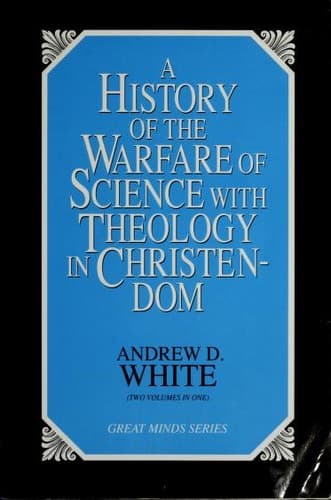
History of the Warfare of Science with Theology in ChristendomWhite, Andrew Dickson
Religion
History of the Warfare of Science with Theology in Christendom
White, Andrew Dickson
Religion and science -- History
(28) For a notice of the views of Cosmas in connection with those of
Lactantius, Augustine, St. John Chrysostom, and others, see Schoell,
Histoire de la Litterature Grecque, vol. vii, p. 37. The main scriptural
passages referred to are as follows: (1) Isaiah xi, 22; (2) Genesis
i, 6; (3) Genesis vii, 11; (4) Exodus xxiv, 10; (5) Job xxvi, 11, and
xxxvii, 18 (6) Psalm cxlviii, 4, and civ, 9; (7) Ezekiel i, 22-26. For
Cosmas's theory, see Montfaucon, Collectio Nova Patrum, Paris, 1706,
vol. ii, p.188; also pp. 298, 299. The text is illustrated with
engravings showing walls and solid vault (firmament), with the whole
apparatus of "fountains of the great deep," "windows of heaven," angels,
and the mountain behind which the sun is drawn. For reduction of one of
them, see Peschel, Gesschichte der Erdkunds, p. 98; also article
Maps, in Knight's Dictionary of Mechanics, New York, 1875. For curious
drawings showing Cosmas's scheme in a different way from that given by
Montfaucon, see extracts from a Vatican codex of the ninth century in
Garucci, Storia de l'Arte Christiana, vol. iii, pp. 70 et seq. For
a good discussion of Cosmas's ideas, see Santarem, Hist. de la
Cosmographie, vol. ii, pp. 8 et seq., and for a very thorough discussion
of its details, Kretschmer, as above. For still another theory, very
droll, and thought out on similar principles, see Mungo Park, cited
in De Morgan, Paradoxes, p. 309. For Cosmas's joyful summing up, see
Montfaucon, Collectio Nova Patrum, vol. ii, p. 255. For the curious
survival in the thirteenth century of the old idea of the "waters above
the heavens," see the story in Gervase of Tilbury, how in his time some
people coming out of church in England found an anchor let down by a
rope out of the heavens, how there came voices from sailors above trying
to loose the anchor, and, finally, how a sailor came down the rope,
who, on reaching the earth, died as if drowned in water. See Gervase of
Tilbury, Otia Imperialia, edit. Liebrecht, Hanover, 1856, Prima Decisio,
cap. xiii. The work was written about 1211. For John of San Germiniano,
see his Summa de Exemplis, lib. ix, cap. 43. For the Egyptian
Trinitarian views, see Sharpe, History of Egypt, vol. i, pp. 94, 102.
Public-domain text, read in full here on John Shaqi.
Reviews
Reviews
No reviews yet
Be the first to share your thoughts on this work.
Elsewhere in the archive
Join the Discussion
Join the discussion
Sign in to leave a comment or review.
Sign InorCreate an account