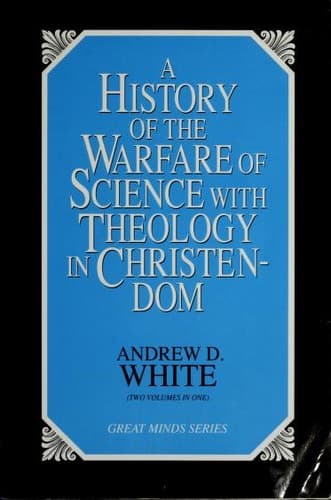
History of the Warfare of Science with Theology in ChristendomWhite, Andrew Dickson
Religion
History of the Warfare of Science with Theology in Christendom
White, Andrew Dickson
Religion and science -- History
But the ancient germ of scientific truth in geography--the idea of the
earth's sphericity--still lived. Although the great majority of the
early fathers of the Church, and especially Lactantius, had sought to
crush it beneath the utterances attributed to Isaiah, David, and
St. Paul, the better opinion of Eudoxus and Aristotle could not be
forgotten. Clement of Alexandria and Origen had even supported it.
Ambrose and Augustine had tolerated it, and, after Cosmas had held sway
a hundred years, it received new life from a great churchman of southern
Europe, Isidore of Seville, who, however fettered by the dominant
theology in many other things, braved it in this. In the eighth century
a similar declaration was made in the north of Europe by another great
Church authority, Bede. Against the new life thus given to the old
truth, the sacred theory struggled long and vigorously but in vain.
Eminent authorities in later ages, like Albert the Great, St. Thomas
Aquinas, Dante, and Vincent of Beauvais, felt obliged to accept the
doctrine of the earth's sphericity, and as we approach the modern period
we find its truth acknowledged by the vast majority of thinking men. The
Reformation did not at first yield fully to this better theory. Luther,
Melanchthon, and Calvin were very strict in their adherence to the exact
letter of Scripture. Even Zwingli, broad as his views generally were,
was closely bound down in this matter, and held to the opinion of the
fathers that a great firmament, or floor, separated the heavens from the
earth; that above it were the waters and angels, and below it the earth
and man.
The main scope given to independent thought on this general subject
among the Reformers was in a few minor speculations regarding the
universe which encompassed Eden, the exact character of the conversation
of the serpent with Eve, and the like.
In the times immediately following the Reformation matters were even
worse. The interpretations of Scripture by Luther and Calvin became as
sacred to their followers as the Scripture itself. When Calixt ventured,
in interpreting the Psalms, to question the accepted belief that "the
waters above the heavens" were contained in a vast receptacle upheld by
a solid vault, he was bitterly denounced as heretical.
In the latter part of the sixteenth century Musaeus interpreted the
accounts in Genesis to mean that first God made the heavens for the roof
or vault, and left it there on high swinging until three days later he
put the earth under it. But the new scientific thought as to the earth's
form had gained the day. The most sturdy believers were obliged to
adjust their, biblical theories to it as best they could.(29)
Public-domain text, read in full here on John Shaqi.
Reviews
Reviews
No reviews yet
Be the first to share your thoughts on this work.
Elsewhere in the archive
Join the Discussion
Join the discussion
Sign in to leave a comment or review.
Sign InorCreate an account