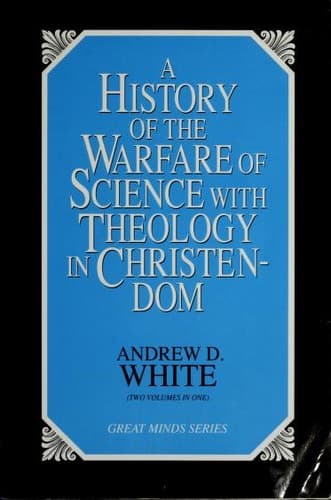
History of the Warfare of Science with Theology in ChristendomWhite, Andrew Dickson
Religion
History of the Warfare of Science with Theology in Christendom
White, Andrew Dickson
Religion and science -- History
This decision seems to have been regarded as final, and five centuries
later the great encyclopedist of the Middle Ages, Vincent of Beauvais,
though he accepts the sphericity of the earth, treats the doctrine
of the antipodes as disproved, because contrary to Scripture. Yet the
doctrine still lived. Just as it had been previously revived by William
of Conches and then laid to rest, so now it is somewhat timidly brought
out in the thirteenth century by no less a personage than Albert the
Great, the most noted man of science in that time. But his utterances
are perhaps purposely obscure. Again it disappears beneath the
theological wave, and a hundred years later Nicolas d'Oresme, geographer
of the King of France, a light of science, is forced to yield to the
clear teaching of the Scripture as cited by St. Augustine.
Nor was this the worst. In Italy, at the beginning of the fourteenth
century, the Church thought it necessary to deal with questions of this
sort by rack and fagot. In 1316 Peter of Abano, famous as a physician,
having promulgated this with other obnoxious doctrines in science, only
escaped the Inquisition by death; and in 1327 Cecco d'Ascoli, noted as
an astronomer, was for this and other results of thought, which brought
him under suspicion of sorcery, driven from his professorship at Bologna
and burned alive at Florence. Nor was this all his punishment: Orcagna,
whose terrible frescoes still exist on the walls of the Campo Santo at
Pisa, immortalized Cecco by representing him in the flames of hell.(35)
(35) For Vincent of Beauvais and the antipode, see his Speculum
Naturale, Book VII, with citations from St. Augustine, De Civitate
Dei, cap. xvi. For Albert the Great's doctrine regarding the antipodes,
compare Kretschmer, as above, with Eicken, Geschichte, etc., p. 621.
Kretschmer finds that Albert supports the doctrine, and Eicken finds
that he denies it--a fair proof that Albert was not inclined to state
his views with dangerous clearness. For D'Oresme, see Santerem, Histoire
de la Cosmographie, vol. i, p. 142. For Peter of Abano, or Apono, as he
is often called, see Tiraboschi, also Guinguene, vol. ii, p. 293;
also Naude, Histoire des Grands Hommes soupconnes de Magie. For Cecco
d'Ascoli, see Montucla, Histoire de Mathematiques, i, 528; also Daunou,
Etudes Historiques, vol. vi, p. 320; also Kretschmer, p. 59. Concerning
Orcagna's representation of Cecco in the flames of hell, see Renan,
Averroes et l'Averroisme, Paris, 1867, p. 328.
Public-domain text, read in full here on John Shaqi.
Reviews
Reviews
No reviews yet
Be the first to share your thoughts on this work.
Elsewhere in the archive
Join the Discussion
Join the discussion
Sign in to leave a comment or review.
Sign InorCreate an account