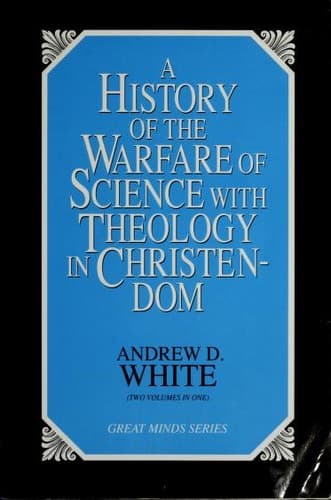
History of the Warfare of Science with Theology in ChristendomWhite, Andrew Dickson
Religion
History of the Warfare of Science with Theology in Christendom
White, Andrew Dickson
Religion and science -- History
The warfare of Columbus the world knows well: how the Bishop of Ceuta
worsted him in Portugal; how sundry wise men of Spain confronted him
with the usual quotations from the Psalms, from St. Paul, and from St.
Augustine; how, even after he was triumphant, and after his voyage had
greatly strengthened the theory of the earth's sphericity, with which
the theory of the antipodes was so closely connected, the Church by its
highest authority solemnly stumbled and persisted in going astray. In
1493 Pope Alexander VI, having been appealed to as an umpire between the
claims of Spain and Portugal to the newly discovered parts of the earth,
issued a bull laying down upon the earth's surface a line of demarcation
between the two powers. This line was drawn from north to south a
hundred leagues west of the Azores; and the Pope in the plenitude of his
knowledge declared that all lands discovered east of this line should
belong to the Portuguese, and all west of it should belong to the
Spaniards. This was hailed as an exercise of divinely illuminated power
by the Church; but difficulties arose, and in 1506 another attempt
was made by Pope Julius II to draw the line three hundred and seventy
leagues west of the Cape Verde Islands. This, again, was supposed to
bring divine wisdom to settle the question; but, shortly, overwhelming
difficulties arose; for the Portuguese claimed Brazil, and, of course,
had no difficulty in showing that they could reach it by sailing to the
east of the line, provided they sailed long enough. The lines laid down
by Popes Alexander and Julius may still be found upon the maps of
the period, but their bulls have quietly passed into the catalogue of
ludicrous errors.
Yet the theological barriers to this geographical truth yielded but
slowly. Plain as it had become to scholars, they hesitated to declare
it to the world at large. Eleven hundred years had passed since St.
Augustine had proved its antagonism to Scripture, when Gregory Reysch
gave forth his famous encyclopaedia, the Margarita Philosophica. Edition
after edition was issued, and everywhere appeared in it the orthodox
statements; but they were evidently strained to the breaking point; for
while, in treating of the antipodes, Reysch refers respectfully to St.
Augustine as objecting to the scientific doctrine, he is careful not to
cite Scripture against it, and not less careful to suggest geographical
reasoning in favour of it.
Public-domain text, read in full here on John Shaqi.
Reviews
Reviews
No reviews yet
Be the first to share your thoughts on this work.
Elsewhere in the archive
Join the Discussion
Join the discussion
Sign in to leave a comment or review.
Sign InorCreate an account