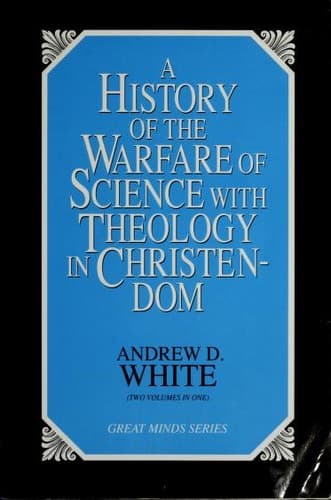
History of the Warfare of Science with Theology in ChristendomWhite, Andrew Dickson
Religion
History of the Warfare of Science with Theology in Christendom
White, Andrew Dickson
Religion and science -- History
Quietly, however, the soil was receiving enrichment and the air warmth.
The processes of mathematics were constantly improved, the heavenly
bodies were steadily observed, and at length appeared, far from the
centres of thought, on the borders of Poland, a plain, simple-minded
scholar, who first fairly uttered to the modern world the truth--now so
commonplace, then so astounding--that the sun and planets do not revolve
about the earth, but that the earth and planets revolve about the sun:
this man was Nicholas Copernicus.
Copernicus had been a professor at Rome, and even as early as 1500
had announced his doctrine there, but more in the way of a scientific
curiosity or paradox, as it had been previously held by Cardinal de
Cusa, than as the statement of a system representing a great fact in
Nature. About thirty years later one of his disciples, Widmanstadt, had
explained it to Clement VII; but it still remained a mere hypothesis,
and soon, like so many others, disappeared from the public view. But
to Copernicus, steadily studying the subject, it became more and more
a reality, and as this truth grew within him he seemed to feel that at
Rome he was no longer safe. To announce his discovery there as a theory
or a paradox might amuse the papal court, but to announce it as a
truth--as THE truth--was a far different matter. He therefore returned
to his little town in Poland.
To publish his thought as it had now developed was evidently dangerous
even there, and for more than thirty years it lay slumbering in the mind
of Copernicus and of the friends to whom he had privately intrusted it.
At last he prepared his great work on the Revolutions of the Heavenly
Bodies, and dedicated it to the Pope himself. He next sought a place of
publication. He dared not send it to Rome, for there were the rulers of
the older Church ready to seize it; he dared not send it to Wittenberg,
for there were the leaders of Protestantism no less hostile; he
therefore intrusted it to Osiander, at Nuremberg.(45)
Public-domain text, read in full here on John Shaqi.
Reviews
Reviews
No reviews yet
Be the first to share your thoughts on this work.
Elsewhere in the archive
Join the Discussion
Join the discussion
Sign in to leave a comment or review.
Sign InorCreate an account