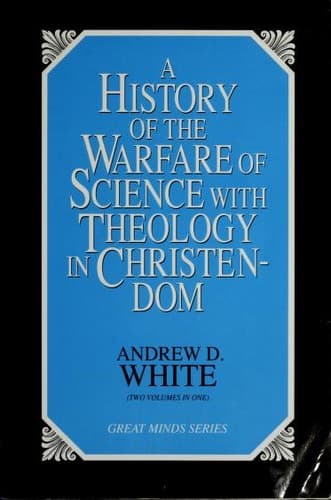
History of the Warfare of Science with Theology in ChristendomWhite, Andrew Dickson
Religion
History of the Warfare of Science with Theology in Christendom
White, Andrew Dickson
Religion and science -- History
Said Martin Luther: "People gave ear to an upstart astrologer who strove
to show that the earth revolves, not the heavens or the firmament, the
sun and the moon. Whoever wishes to appear clever must devise some
new system, which of all systems is of course the very best. This fool
wishes to reverse the entire science of astronomy; but sacred Scripture
tells us that Joshua commanded the sun to stand still, and not the
earth." Melanchthon, mild as he was, was not behind Luther in condemning
Copernicus. In his treatise on the Elements of Physics, published six
years after Copernicus's death, he says: "The eyes are witnesses that
the heavens revolve in the space of twenty-four hours. But certain men,
either from the love of novelty, or to make a display of ingenuity,
have concluded that the earth moves; and they maintain that neither the
eighth sphere nor the sun revolves.... Now, it is a want of honesty and
decency to assert such notions publicly, and the example is pernicious.
It is the part of a good mind to accept the truth as revealed by God and
to acquiesce in it." Melanchthon then cites the passages in the Psalms
and Ecclesiastes, which he declares assert positively and clearly that
the earth stands fast and that the sun moves around it, and adds eight
other proofs of his proposition that "the earth can be nowhere if not
in the centre of the universe." So earnest does this mildest of the
Reformers become, that he suggests severe measures to restrain such
impious teachings as those of Copernicus.(50)
(50) See the Tischreden in the Walsch edition of Luther's Works, 1743,
vol. xxii, p. 2260; also Melanchthon's Initia Doctrinae Physicae.
This treatise is cited under a mistaken title by the Catholic World,
September, 1870. The correct title is as given above; it will be found
in the Corpus Reformatorum, vol. xiii (ed. Bretschneider, Halle, 1846),
pp. 216, 217. See also Madler, vol. i, p. 176; also Lange, Geschichte
des Materialismus, vol. i, p. 217; also Prowe, Ueber die Abhangigkeit
des Copernicus, Thorn, 1865, p. 4; also note, pp. 5, 6, where text is
given in full.
Public-domain text, read in full here on John Shaqi.
Reviews
Reviews
No reviews yet
Be the first to share your thoughts on this work.
Elsewhere in the archive
Join the Discussion
Join the discussion
Sign in to leave a comment or review.
Sign InorCreate an account