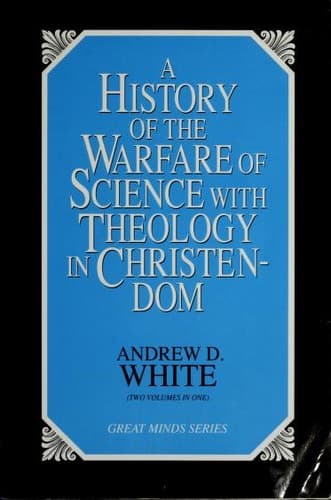
History of the Warfare of Science with Theology in ChristendomWhite, Andrew Dickson
Religion
History of the Warfare of Science with Theology in Christendom
White, Andrew Dickson
Religion and science -- History
Why the people at large took this view is easily understood when we note
the attitude of the guardians of learning, both Catholic and Protestant,
in that age. It throws great light upon sundry claims by modern
theologians to take charge of public instruction and of the evolution
of science. So important was it thought to have "sound learning" guarded
and "safe science" taught, that in many of the universities, as late as
the end of the seventeenth century, professors were forced to take an
oath not to hold the "Pythagorean"--that is, the Copernican--idea as to
the movement of the heavenly bodies. As the contest went on, professors
were forbidden to make known to students the facts revealed by
the telescope. Special orders to this effect were issued by the
ecclesiastical authorities to the universities and colleges of Pisa,
Innspruck, Louvain, Douay, Salamanca, and others. During generations we
find the authorities of these Universities boasting that these godless
doctrines were kept away from their students. It is touching to hear
such boasts made then, just as it is touching now to hear sundry
excellent university authorities boast that they discourage the reading
of Mill, Spencer, and Darwin. Nor were such attempts to keep the truth
from students confined to the Roman Catholic institutions of learning.
Strange as it may seem, nowhere were the facts confirming the Copernican
theory more carefully kept out of sight than at Wittenberg--the
university of Luther and Melanchthon. About the middle of the sixteenth
century there were at that centre of Protestant instruction two
astronomers of a very high order, Rheticus and Reinhold; both of these,
after thorough study, had convinced themselves that the Copernican
system was true, but neither of them was allowed to tell this truth to
his students. Neither in his lecture announcements nor in his published
works did Rheticus venture to make the new system known, and he at
last gave up his professorship and left Wittenberg, that he might have
freedom to seek and tell the truth. Reinhold was even more wretchedly
humiliated. Convinced of the truth of the new theory, he was obliged to
advocate the old; if he mentioned the Copernican ideas, he was compelled
to overlay them with the Ptolemaic. Even this was not thought safe
enough, and in 1571 the subject was intrusted to Peucer. He was
eminently "sound," and denounced the Copernican theory in his lectures
as "absurd, and unfit to be introduced into the schools."
To clinch anti-scientific ideas more firmly into German Protestant
teaching, Rector Hensel wrote a text-book for schools entitled The
Restored Mosaic System of the World, which showed the Copernican
astronomy to be unscriptural.
Public-domain text, read in full here on John Shaqi.
Reviews
Reviews
No reviews yet
Be the first to share your thoughts on this work.
Elsewhere in the archive
Join the Discussion
Join the discussion
Sign in to leave a comment or review.
Sign InorCreate an account