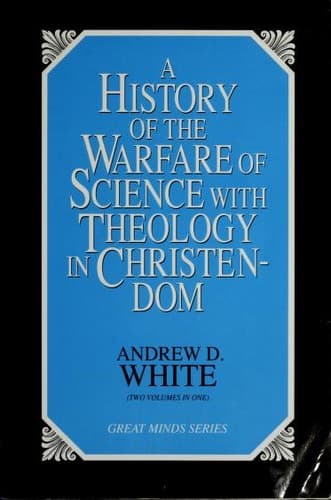
History of the Warfare of Science with Theology in ChristendomWhite, Andrew Dickson
Religion
History of the Warfare of Science with Theology in Christendom
White, Andrew Dickson
Religion and science -- History
(59) For various objectors and objections to Galileo by his
contemporaries, see Libri, Histoire des Sciences mathematiques en
Italie, vol. iv, p. 233, 234; also Martin, Vie de Galilee. For Father
Lecazre's argument, see Flammarion, Mondes imaginaires et mondes reels,
6th ed., pp. 315, 316. For Melanchthon's argument, see his Initia in
Opera, vol. iii, Halle, 1846.
These epithets can hardly be classed with civilized weapons. They are
burning arrows; they set fire to masses of popular prejudice, always
obscuring the real question, sometimes destroying the attacking party.
They are poisoned weapons. They pierce the hearts of loving women; they
alienate dear children; they injure a man after life is ended, for they
leave poisoned wounds in the hearts of those who loved him best--fears
for his eternal salvation, dread of the Divine wrath upon him. Of
course, in these days these weapons, though often effective in vexing
good men and in scaring good women, are somewhat blunted; indeed, they
not infrequently injure the assailants more than the assailed. So it was
not in the days of Galileo; they were then in all their sharpness and
venom.(60)
(60) For curious exemplification of the way in which these weapons
have been hurled, see lists of persons charged with "infidelity" and
"atheism," in the Dictionnaire des Athees., Paris, (1800); also Lecky,
History of Rationalism, vol. ii, p. 50. For the case of Descartes, see
Saisset, Descartes et ses Precurseurs, pp. 103, 110. For the facility
with which the term "atheist" has been applied from the early Aryans
down to believers in evolution, see Tylor, Primitive Culture, vol. i, p.
420.
Yet a baser warfare was waged by the Archbishop of Pisa. This man, whose
cathedral derives its most enduring fame from Galileo's deduction of a
great natural law from the swinging lamp before its altar, was not an
archbishop after the noble mould of Borromeo and Fenelon and Cheverus.
Sadly enough for the Church and humanity, he was simply a zealot and
intriguer: he perfected the plan for entrapping the great astronomer.
Galileo, after his discoveries had been denounced, had written to his
friend Castelli and to the Grand-Duchess Christine two letters to show
that his discoveries might be reconciled with Scripture. On a hint from
the Inquisition at Rome, the archbishop sought to get hold of these
letters and exhibit them as proofs that Galileo had uttered heretical
views of theology and of Scripture, and thus to bring him into the
clutch of the Inquisition. The archbishop begs Castelli, therefore, to
let him see the original letter in the handwriting of Galileo. Castelli
declines. The archbishop then, while, as is now revealed, writing
constantly and bitterly to the Inquisition against Galileo, professes
to Castelli the greatest admiration of Galileo's genius and a sincere
desire to know more of his discoveries. This not succeeding, the
archbishop at last throws off the mask and resorts to open attack.
Public-domain text, read in full here on John Shaqi.
History of the Warfare of Science with Theology in Christendom — John Shaqi
Reviews
Reviews
No reviews yet
Be the first to share your thoughts on this work.
Elsewhere in the archive
Join the Discussion
Join the discussion
Sign in to leave a comment or review.
Sign InorCreate an account