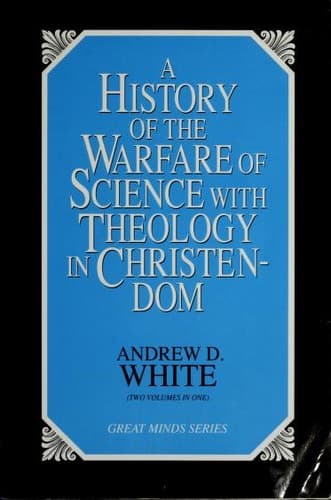
History of the Warfare of Science with Theology in ChristendomWhite, Andrew Dickson
Religion
History of the Warfare of Science with Theology in Christendom
White, Andrew Dickson
Religion and science -- History
This new work of Galileo--the Dialogo--appeared in 1632, and met with
prodigious success. It put new weapons into the hands of the supporters
of the Copernican theory. The pious preface was laughed at from one end
of Europe to the other. This roused the enemy; the Jesuits, Dominicans,
and the great majority of the clergy returned to the attack more violent
than ever, and in the midst of them stood Pope Urban VIII, most bitter
of all. His whole power was now thrown against Galileo. He was touched
in two points: first, in his personal vanity, for Galileo had put the
Pope's arguments into the mouth of one of the persons in the dialogue
and their refutation into the mouth of another; but, above all, he was
touched in his religious feelings. Again and again His Holiness
insisted to all comers on the absolute and specific declarations of Holy
Scripture, which prove that the sun and heavenly bodies revolve about
the earth, and declared that to gainsay them is simply to dispute
revelation. Certainly, if one ecclesiastic more than another ever seemed
NOT under the care of the Spirit of Truth, it was Urban VIII in all this
matter.
Herein was one of the greatest pieces of ill fortune that has ever
befallen the older Church. Had Pope Urban been broad-minded and tolerant
like Benedict XIV, or had he been taught moderation by adversity like
Pius VII, or had he possessed the large scholarly qualities of Leo XIII,
now reigning, the vast scandal of the Galileo case would never have
burdened the Church: instead of devising endless quibbles and special
pleadings to escape responsibility for this colossal blunder, its
defenders could have claimed forever for the Church the glory of
fearlessly initiating a great epoch in human thought.
But it was not so to be. Urban was not merely Pope; he was also a prince
of the house of Barberini, and therefore doubly angry that his arguments
had been publicly controverted.
Public-domain text, read in full here on John Shaqi.
Reviews
Reviews
No reviews yet
Be the first to share your thoughts on this work.
Elsewhere in the archive
Join the Discussion
Join the discussion
Sign in to leave a comment or review.
Sign InorCreate an account