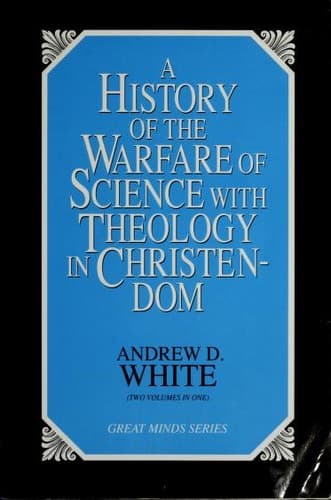
History of the Warfare of Science with Theology in ChristendomWhite, Andrew Dickson
Religion
History of the Warfare of Science with Theology in Christendom
White, Andrew Dickson
Religion and science -- History
Many have wondered at this abjuration, and on account of it have denied
to Galileo the title of martyr. But let such gainsayers consider the
circumstances. Here was an old man--one who had reached the allotted
threescore years and ten--broken with disappointments, worn out with
labours and cares, dragged from Florence to Rome, with the threat from
the Pope himself that if he delayed he should be "brought in chains";
sick in body and mind, given over to his oppressors by the Grand-Duke
who ought to have protected him, and on his arrival in Rome threatened
with torture. What the Inquisition was he knew well. He could remember
as but of yesterday the burning of Giordano Bruno in that same city for
scientific and philosophic heresy; he could remember, too, that only
eight years before this very time De Dominis, Archbishop of Spalatro,
having been seized by the Inquisition for scientific and other heresies,
had died in a dungeon, and that his body and his writings had been
publicly burned.
To the end of his life--nay, after his life was ended--the persecution
of Galileo was continued. He was kept in exile from his family, from his
friends, from his noble employments, and was held rigidly to his
promise not to speak of his theory. When, in the midst of intense bodily
sufferings from disease, and mental sufferings from calamities in his
family, he besought some little liberty, he was met with threats of
committal to a dungeon. When, at last, a special commission had reported
to the ecclesiastical authorities that he had become blind and wasted
with disease and sorrow, he was allowed a little more liberty, but
that little was hampered by close surveillance. He was forced to bear
contemptible attacks on himself and on his works in silence; to see the
men who had befriended him severely punished; Father Castelli banished;
Ricciardi, the Master of the Sacred Palace, and Ciampoli, the papal
secretary, thrown out of their positions by Pope Urban, and the
Inquisitor at Florence reprimanded for having given permission to print
Galileo's work. He lived to see the truths he had established carefully
weeded out from all the Church colleges and universities in Europe; and,
when in a scientific work he happened to be spoken of as "renowned," the
Inquisition ordered the substitution of the word "notorious."(64)
(64) For the substitution of the word "notorious" for "renowned" by
order of the Inquisition, see Martin, p.227.
Public-domain text, read in full here on John Shaqi.
Reviews
Reviews
No reviews yet
Be the first to share your thoughts on this work.
Elsewhere in the archive
Join the Discussion
Join the discussion
Sign in to leave a comment or review.
Sign InorCreate an account