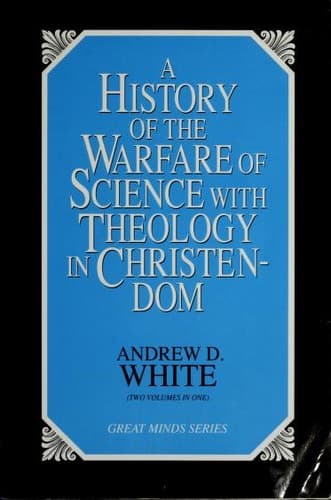
History of the Warfare of Science with Theology in ChristendomWhite, Andrew Dickson
Religion
History of the Warfare of Science with Theology in Christendom
White, Andrew Dickson
Religion and science -- History
The author then goes on to show from Scripture the folly, not only of
Copernicus and Newton, but of a long line of great astronomers in more
recent times. He declares: "Let no one understand me as inquiring first
where truth is to be found--in the Bible or with the astronomers. No; I
know that beforehand--that my God never lies, never makes a mistake; out
of his mouth comes only truth, when he speaks of the structure of the
universe, of the earth, sun, moon, and stars....
"Because the truth of the Holy Scripture is involved in this, therefore
the above question is of the highest importance to me.... Scientists and
others lean upon the miserable reed (Rohrstab) that God teaches only the
order of salvation, but not the order of the universe."
Very noteworthy is the fact that this late survival of an ancient belief
based upon text-worship is found, not in the teachings of any zealous
priest of the mother Church, but in those of an eminent professor in
that branch of Protestantism which claims special enlightenment.(70)
(70) For the amusing details of the attempt in the English Church to
repress science, and of the way in which it was met, see De Morgan,
Paradoxes, p. 42. For Pastor Knak and his associates, see the Revue des
Deux Mondes, 1868. Of the recent Lutheran works against the Copernican
astronomy, see especially Astronomische Unterredung zwischen einem
Liebhaber der Astronomie und mehreren beruhmten Astronomer der Neuzeit,
by J. C. W. L., St. Louis, 1873.
Nor has the warfare against the dead champions of science been carried
on by the older Church alone.
On the 10th of May, 1859, Alexander von Humboldt was buried. His labours
had been among the glories of the century, and his funeral was one of
the most imposing that Berlin had ever seen. Among those who honoured
themselves by their presence was the prince regent, afterward the
Emperor William I; but of the clergy it was observed that none
were present save the officiating clergyman and a few regarded as
unorthodox.(71)
(71) See Bruhns and Lassell, Life of Humboldt, London, 1873, vol. ii, p.
411.
V. RESULTS OF THE VICTORY OVER GALILEO.
We return now to the sequel of the Galileo case.
Having gained their victory over Galileo, living and dead, having used
it to scare into submission the professors of astronomy throughout
Europe, conscientious churchmen exulted. Loud was their rejoicing that
the "heresy," the "infidelity" the "atheism" involved in believing that
the earth revolves about its axis and moves around the sun had been
crushed by the great tribunal of the Church, acting in strict obedience
to the expressed will of one Pope and the written order of another. As
we have seen, all books teaching this hated belief were put upon the
Index of books forbidden to Christians, and that Index was prefaced by
a bull enforcing this condemnation upon the consciences of the faithful
throughout the world, and signed by the reigning Pope.
Public-domain text, read in full here on John Shaqi.
Reviews
Reviews
No reviews yet
Be the first to share your thoughts on this work.
Elsewhere in the archive
Join the Discussion
Join the discussion
Sign in to leave a comment or review.
Sign InorCreate an account