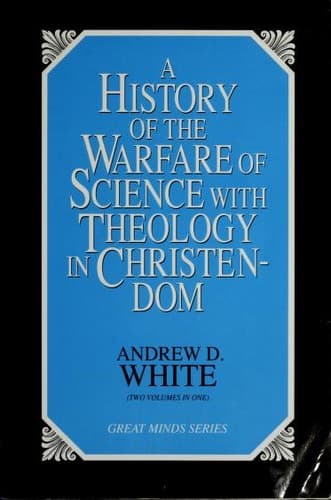
History of the Warfare of Science with Theology in ChristendomWhite, Andrew Dickson
Religion
History of the Warfare of Science with Theology in Christendom
White, Andrew Dickson
Religion and science -- History
Out of the ancient world had come a mass of beliefs regarding comets,
meteors, and eclipses; all these were held to be signs displayed from
heaven for the warning of mankind. Stars and meteors were generally
thought to presage happy events, especially the births of gods, heroes,
and great men. So firmly rooted was this idea that we constantly find
among the ancient nations traditions of lights in the heavens preceding
the birth of persons of note. The sacred books of India show that
the births of Crishna and of Buddha were announced by such heavenly
lights.(89) The sacred books of China tell of similar appearances at
the births of Yu, the founder of the first dynasty, and of the inspired
sage, Lao-tse. According to the Jewish legends, a star appeared at the
birth of Moses, and was seen by the Magi of Egypt, who informed the
king; and when Abraham was born an unusual star appeared in the east.
The Greeks and Romans cherished similar traditions. A heavenly light
accompanied the birth of Aesculapius, and the births of various Caesars
were heralded in like manner.(90)
(89) For Crishna, see Cox, Aryan Mythology, vol. ii, p. 133; the Vishnu
Purana (Wilson's translation), book v, chap. iv. As to lights at
the birth, or rather at the conception, of Buddha, see Bunsen, Angel
Messiah, pp. 22,23; Alabaster, Wheel of the Law (illustrations of
Buddhism), p. 102; Edwin Arnold, Light of Asia; Bp. Bigandet, Life
of Gaudama, the Burmese Buddha, p. 30; Oldenberg, Buddha (English
translation), part i, chap. ii.
(90) For Chinese legends regarding stars at the birth of Yu and
Lao-tse, see Thornton, History of China, vol. i, p. 137; also Pingre,
Cometographie, p. 245. Regarding stars at the birth of Moses and
Abraham, see Calmet, Fragments, part viii; Baring-Gould, Legends of Old
Testament Characters, chap. xxiv; Farrar, Life of Christ, chap. iii. As
to the Magi, see Higgins, Anacalypsis; Hooykaas, Ort, and Kuenen,
Bible for Learners, vol. iii. For Greek and Roman traditions, see Bell,
Pantheon, s. v. Aesculapius and Atreus; Gibbon, Decline and Fall, vol.
i, pp. 151, 590; Farrar, Life of Christ (American edition), p. 52; Cox,
Tales of Ancient Greece, pp. 41, 61, 62; Higgins, Anacalypsis, vol. i,
p. 322; also Suetonius, Caes., Julius, p.88, Claud., p. 463; Seneca,
Nat. Quaest, vol. 1, p. 1; Virgil, Ecl., vol. ix, p. 47; as well as
Ovid, Pliny, and others.
The same conception entered into our Christian sacred books. Of all the
legends which grew in such luxuriance and beauty about the cradle of
Jesus of Nazareth, none appeals more directly to the highest poetic
feeling than that given by one of the evangelists, in which a star,
rising in the east, conducted the wise men to the manger where the
Galilean peasant-child--the Hope of Mankind, the Light of the World--was
lying in poverty and helplessness.
Public-domain text, read in full here on John Shaqi.
Reviews
Reviews
No reviews yet
Be the first to share your thoughts on this work.
Elsewhere in the archive
Join the Discussion
Join the discussion
Sign in to leave a comment or review.
Sign InorCreate an account