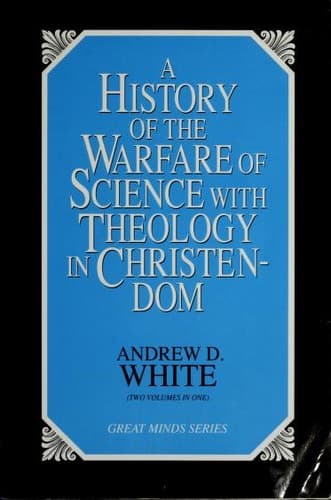
History of the Warfare of Science with Theology in ChristendomWhite, Andrew Dickson
Religion
History of the Warfare of Science with Theology in Christendom
White, Andrew Dickson
Religion and science -- History
(101) For Thoresby, see his Diary, (London, 1830). Halley's great
service is described further on in this chapter. For Nikon's speech, see
Dean Stanley's History of the Eastern Church, p. 485. For very striking
examples of this mediaeval terror in Germany, see Von Raumer, Geschichte
der Hohenstaufen, vol. vi, p. 538. For the Reformation period, see Wolf,
Gesch. d. Astronomie; also Praetorius, Ueber d. Cometstern (Erfurt,
1589), in which the above sentences of Luther are printed on the title
page as epigraphs. For "Huren-Sternen," see the sermon of Celichius,
described later.
Melanchthon, too, in various letters refers to comets as heralds of
Heaven's wrath, classing them, with evil conjunctions of the planets and
abortive births, among the "signs" referred to in Scripture. Zwingli,
boldest of the greater Reformers in shaking off traditional beliefs,
could not shake off this, and insisted that the comet of 1531 betokened
calamity. Arietus, a leading Protestant theologian, declared, "The
heavens are given us not merely for our pleasure, but also as a warning
of the wrath of God for the correction of our lives." Lavater insisted
that comets are signs of death or calamity, and cited proofs from
Scripture.
Catholic and Protestant strove together for the glory of this doctrine.
It was maintained with especial vigour by Fromundus, the eminent
professor and Doctor of Theology at the Catholic University of Louvain,
who so strongly opposed the Copernican system; at the beginning of the
seventeenth century, even so gifted an astronomer as Kepler yielded
somewhat to the belief; and near the end of that century Voigt declared
that the comet of 1618 clearly presaged the downfall of the Turkish
Empire, and he stigmatized as "atheists and Epicureans" all who did not
believe comets to be God's warnings.(102)
(102) For Melanchthon, see Wolf, ubi supra. For Zwingli, see Wolf, p.
235. For Arietus, see Madler, Geschichte der Himmelskunde, vol. ii. For
Kepler's superstition, see Wolf, p. 281. For Voight, see Himmels-Manaten
Reichstage, Hamburg, 1676. For both Fromundus and Voigt, see also
Madler, vol. ii, p. 399, and Lecky, Rationalism in Europe, vol. i, p.28.
II. THEOLOGICAL EFFORTS TO CRUSH THE SCIENTIFIC VIEW.
Public-domain text, read in full here on John Shaqi.
Reviews
Reviews
No reviews yet
Be the first to share your thoughts on this work.
Elsewhere in the archive
Join the Discussion
Join the discussion
Sign in to leave a comment or review.
Sign InorCreate an account