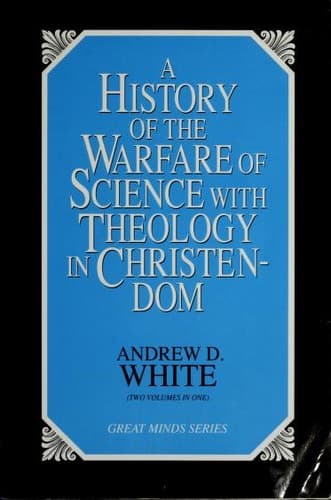
History of the Warfare of Science with Theology in ChristendomWhite, Andrew Dickson
Religion
History of the Warfare of Science with Theology in Christendom
White, Andrew Dickson
Religion and science -- History
In our own country superstitious ideas regarding comets continued to
have some little currency; but their life was short. The tendency shown
by Cotton Mather, at the beginning of the eighteenth century, toward
acknowledging the victory of science, was completed by the utterances
of Winthrop, professor at Harvard, who in 1759 published two lectures
on comets, in which he simply and clearly revealed the truth, never
scoffing, but reasoning quietly and reverently. In one passage he says:
"To be thrown into a panic whenever a comet appears, on account of the
ill effects which some few of them might possibly produce, if they were
not under proper direction, betrays a weakness unbecoming a reasonable
being."
A happy influence in this respect was exercised on both continents by
John Wesley. Tenaciously as he had held to the supposed scriptural view
in so many other matters of science, in this he allowed his reason
to prevail, accepted the demonstrations of Halley, and gloried in
them.(124)
(124) For Heyn, see his Versuch einer Betrachtung uber die cometun, die
Sundfluth und das Vorspeil des jungsten Gerichts, Leipsic, 1742. A Latin
version, of the same year, bears the title, Specimen Cometologiae Sacre.
For the theory that the earth encountered the tail of a comet, see
Guillemin and Watson. For survival of the old idea in America, see a
Sermon of Israel Loring, of Sudbury, published in 1722. For Prof.
J. Winthrop, see his Comets. For Wesley, see his Natural Philosophy,
London, 1784, vol. iii, p. 303.
Public-domain text, read in full here on John Shaqi.
Reviews
Reviews
No reviews yet
Be the first to share your thoughts on this work.
Elsewhere in the archive
Join the Discussion
Join the discussion
Sign in to leave a comment or review.
Sign InorCreate an account