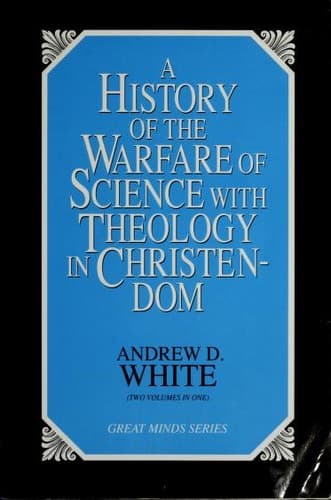
History of the Warfare of Science with Theology in ChristendomWhite, Andrew Dickson
Religion
History of the Warfare of Science with Theology in Christendom
White, Andrew Dickson
Religion and science -- History
These general lines of thought upon geology and its kindred science of
zoology were followed by St. Thomas Aquinas and by the whole body
of medieval theologians, so far as they gave any attention to such
subjects.
The next development of geology, mainly under Church guidance, was by
means of the scholastic theology. Phrase-making was substituted for
investigation. Without the Church and within it wonderful contributions
were thus made. In the eleventh century Avicenna accounted for the
fossils by suggesting a "stone-making force";(129) in the thirteenth,
Albert the Great attributed them to a "formative quality;"(130) in the
following centuries some philosophers ventured the idea that they grew
from seed; and the Aristotelian doctrine of spontaneous generation was
constantly used to prove that these stony fossils possessed powers of
reproduction like plants and animals.(131)
(129) Vis lapidifica.
(130) Virtus formativa.
(131) See authorities given in Mr. Ward's assay, as above.
Still, at various times and places, germs implanted by Greek and Roman
thought were warmed into life. The Arabian schools seem to have been
less fettered by the letter of the Koran than the contemporary Christian
scholars by the letter of the Bible; and to Avicenna belongs the credit
of first announcing substantially the modern geological theory of
changes in the earth's surface.(132)
(132) For Avicenna, see Lyell and D'Archiac.
The direct influence of the Reformation was at first unfavourable to
scientific progress, for nothing could be more at variance with any
scientific theory of the development of the universe than the ideas of
the Protestant leaders. That strict adherence to the text of Scripture
which made Luther and Melanchthon denounce the idea that the planets
revolve about the sun, was naturally extended to every other scientific
statement at variance with the sacred text. There is much reason to
believe that the fetters upon scientific thought were closer under the
strict interpretation of Scripture by the early Protestants than they
had been under the older Church. The dominant spirit among the Reformers
is shown by the declaration of Peter Martyr to the effect that, if
a wrong opinion should obtain regarding the creation as described in
Genesis, "all the promises of Christ fall into nothing, and all the life
of our religion would be lost."(133)
(133) See his Commentary on Genesis, cited by Zoeckler, Geschichte der
Beziehungen zwischen Theologie und Naturwissenschaft, vol. i, p. 690.
Public-domain text, read in full here on John Shaqi.
Reviews
Reviews
No reviews yet
Be the first to share your thoughts on this work.
Elsewhere in the archive
Join the Discussion
Join the discussion
Sign in to leave a comment or review.
Sign InorCreate an account