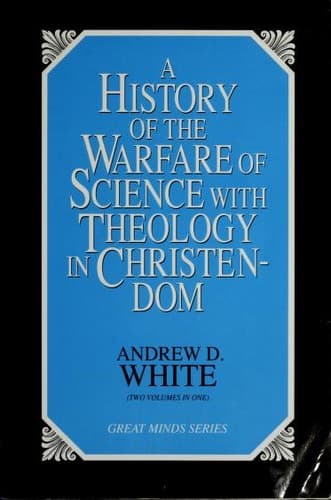
History of the Warfare of Science with Theology in ChristendomWhite, Andrew Dickson
Religion
History of the Warfare of Science with Theology in Christendom
White, Andrew Dickson
Religion and science -- History
The work was written with much power, and attracted universal attention.
It was translated into various languages, and called forth a multitude
of supporters and opponents in all parts of Europe. Strong men rose
against it, especially in England, and among them a few dignitaries of
the Church; but the Church generally hailed the work with joy. Addison
praised it in a Latin ode, and for nearly a century it exercised a
strong influence upon European feeling, and aided to plant more deeply
than ever the theological opinion that the earth as now existing
is merely a ruin; whereas, before sin brought on the Flood, it was
beautiful in its "egg-shaped form," and free from every imperfection.
A few years later came another writer of the highest standing--William
Whiston, professor at Cambridge, who in 1696 published his New Theory
of the Earth. Unlike Burnet, he endeavoured to avail himself of the
Newtonian idea, and brought in, to aid the geological catastrophe caused
by human sin, a comet, which broke open "the fountains of the great
deep."
But, far more important than either of these champions, there arose in
the eighteenth century, to aid in the subjection of science to theology,
three men of extraordinary power--John Wesley, Adam Clarke, and Richard
Watson. All three were men of striking intellectual gifts, lofty
character, and noble purpose, and the first-named one of the greatest
men in English history; yet we find them in geology hopelessly fettered
by the mere letter of Scripture, and by a temporary phase in theology.
As in regard to witchcraft and the doctrine of comets, so in regard to
geology, this theological view drew Wesley into enormous error.(143)
The great doctrine which Wesley, Watson, Clarke, and their compeers,
following St. Augustine, Bede, Peter Lombard, and a long line of the
greatest minds in the universal Church, thought it especially necessary
to uphold against geologists was, that death entered the world by
sin--by the first transgression of Adam and Eve. The extent to which the
supposed necessity of upholding this doctrine carried Wesley seems now
almost beyond belief. Basing his theology on the declaration that the
Almighty after creation found the earth and all created things "very
good," he declares, in his sermon on the Cause and Cure of Earthquakes,
that no one who believes the Scriptures can deny that "sin is the moral
cause of earthquakes, whatever their natural cause may be." Again,
he declares that earthquakes are the "effect of that curse which was
brought upon the earth by the original transgression." Bringing into
connection with Genesis the declaration of St. Paul that "the whole
creation groaneth and travaileth together in pain until now," he finds
additional scriptural proof that the earthquakes were the result of
Adam's fall. He declares, in his sermon on God's Approbation of His
Works, that "before the sin of Adam there were no agitations within
Public-domain text, read in full here on John Shaqi.
Reviews
Reviews
No reviews yet
Be the first to share your thoughts on this work.
Elsewhere in the archive
Join the Discussion
Join the discussion
Sign in to leave a comment or review.
Sign InorCreate an account