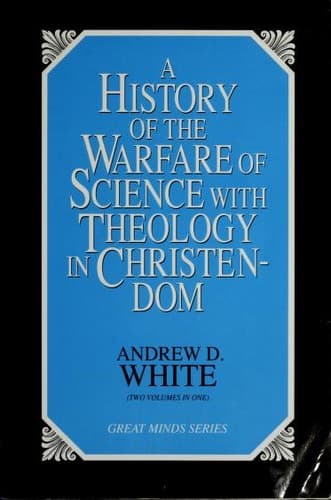
History of the Warfare of Science with Theology in ChristendomWhite, Andrew Dickson
Religion
History of the Warfare of Science with Theology in Christendom
White, Andrew Dickson
Religion and science -- History
In the Lutheran branch of the Protestant Church we also find echoes
of the old belief. Keil, eminent in scriptural interpretation at the
University of Dorpat, gave forth in 1860 a treatise insisting that
geology is rendered futile and its explanations vain by two great facts:
the Curse which drove Adam and Eve out of Eden, and the Flood that
destroyed all living things save Noah, his family, and the animals in
the ark. In 1867, Phillippi, and in 1869, Dieterich, both theologians
of eminence, took virtually the same ground in Germany, the latter
attempting to beat back the scientific hosts with a phrase apparently
pithy, but really hollow--the declaration that "modern geology observes
what is, but has no right to judge concerning the beginning of things."
As late as 1876, Zugler took a similar view, and a multitude of lesser
lights, through pulpit and press, brought these antiscientific doctrines
to bear upon the people at large--the only effect being to arouse grave
doubts regarding Christianity among thoughtful men, and especially among
young men, who naturally distrusted a cause using such weapons.
For just at this time the traditional view of the Deluge received its
death-blow, and in a manner entirely unexpected. By the investigations
of George Smith among the Assyrian tablets of the British Museum, in
1872, and by his discoveries just afterward in Assyria, it was put
beyond a reasonable doubt that a great mass of accounts in Genesis
are simply adaptations of earlier and especially of Chaldean myths and
legends. While this proved to be the fact as regards the accounts of
Creation and the fall of man, it was seen to be most strikingly so as
regards the Deluge. The eleventh of the twelve tablets, on which the
most important of these inscriptions was found, was almost wholly
preserved, and it revealed in this legend, dating from a time far
earlier than that of Moses, such features peculiar to the childhood of
the world as the building of the great ship or ark to escape the flood,
the careful caulking of its seams, the saving of a man beloved of
Heaven, his selecting and taking with him into the vessel animals of all
sorts in couples, the impressive final closing of the door, the sending
forth different birds as the flood abated, the offering of sacrifices
when the flood had subsided, the joy of the Divine Being who had caused
the flood as the odour of the sacrifice reached his nostrils; while
throughout all was shown that partiality for the Chaldean sacred number
seven which appears so constantly in the Genesis legends and throughout
the Hebrew sacred books.
Other devoted scholars followed in the paths thus opened--Sayce in
England, Lenormant in France, Schrader in Germany--with the result that
the Hebrew account of the Deluge, to which for ages theologians had
obliged all geological research to conform, was quietly relegated,
even by most eminent Christian scholars, to the realm of myth and
legend.(174)
Public-domain text, read in full here on John Shaqi.
Reviews
Reviews
No reviews yet
Be the first to share your thoughts on this work.
Elsewhere in the archive
Join the Discussion
Join the discussion
Sign in to leave a comment or review.
Sign InorCreate an account