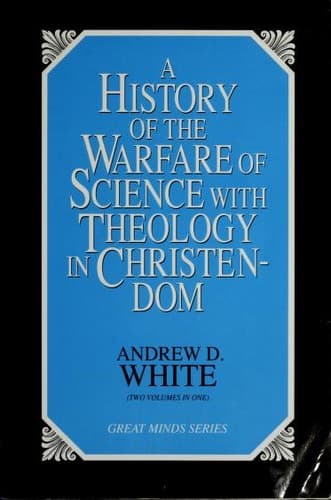
History of the Warfare of Science with Theology in ChristendomWhite, Andrew Dickson
Religion
History of the Warfare of Science with Theology in Christendom
White, Andrew Dickson
Religion and science -- History
About the middle of the seventeenth century Isaac Vossius, one of the
most eminent scholars of Christendom, attempted to bring the prevailing
belief into closer accordance with ascertained facts, but, save by a
chosen few, his efforts were rejected. In some parts of Europe a man
holding new views on chronology was by no means safe from bodily harm.
As an example of the extreme pressure exerted by the old theological
system at times upon honest scholars, we may take the case of La
Peyrere, who about the middle of the seventeenth century put forth his
book on the Pre-Adamites--an attempt to reconcile sundry well-known
difficulties in Scripture by claiming that man existed on earth before
the time of Adam. He was taken in hand at once; great theologians rushed
forward to attack him from all parts of Europe; within fifty years
thirty-six different refutations of his arguments had appeared;
the Parliament of Paris burned the book, and the Grand Vicar of the
archdiocese of Mechlin threw him into prison and kept him there until
he was forced, not only to retract his statements, but to abjure his
Protestantism.
In England, opposition to the growing truth was hardly less earnest.
Especially strong was Pearson, afterward Master of Trinity and Bishop
of Chester. In his treatise on the Creed, published in 1659, which has
remained a theologic classic, he condemned those who held the earth to
be more than fifty-six hundred years old, insisted that the first man
was created just six days later, declared that the Egyptian records were
forged, and called all Christians to turn from them to "the infallible
annals of the Spirit of God."
But, in spite of warnings like these, we see the new idea cropping out
in various parts of Europe. In 1672, Sir John Marsham published a work
in which he showed himself bold and honest. After describing the heathen
sources of Oriental history, he turns to the Christian writers,
and, having used the history of Egypt to show that the great Church
authorities were not exact, he ends one important argument with the
following words: "Thus the most interesting antiquities of Egypt have
been involved in the deepest obscurity by the very interpreters of
her chronology, who have jumbled everything up (qui omnia susque deque
permiscuerunt), so as to make them match with their own reckonings
of Hebrew chronology. Truly a very bad example, and quite unworthy of
religious writers."
Public-domain text, read in full here on John Shaqi.
Reviews
Reviews
No reviews yet
Be the first to share your thoughts on this work.
Elsewhere in the archive
Join the Discussion
Join the discussion
Sign in to leave a comment or review.
Sign InorCreate an account