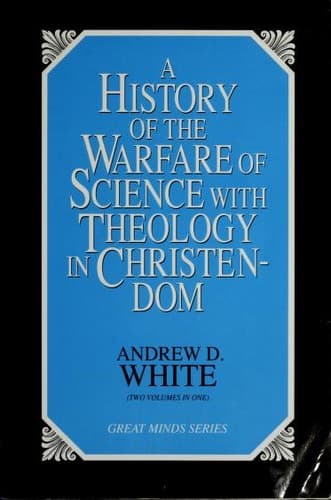
History of the Warfare of Science with Theology in ChristendomWhite, Andrew Dickson
Religion
History of the Warfare of Science with Theology in Christendom
White, Andrew Dickson
Religion and science -- History
(183) For Lightfoot, see his Prolegomena relating to the age of the
world at the birth of Christ; see also in the edition of his works,
London, 1822, vol. 4, pp. 64, 112. For Scaliger, see in the De
Emendatione Temporum, 1583; also Mark Pattison, Essays, Oxford, 1889,
vol. i, pp. 162 et seq. For Raleigh's misgivings, see his History of the
World, London, 1614, p. 227, book ii of part i, section 7 of chapter
i; also Clinton's Fasti Hellenici, vol. ii, p. 293. For Usher, see
his Annales Vet. et Nov. Test., London, 1650. For Pearson, see his
Exposition of the Creed, sixth edition, London, 1692, pp. 59 et seq.
For Marsham, see his Chronicus Canon Aegypticus, Ebraicus, Graecus,
et Disquisitiones, London, 1672. For La Peyrere, see especially
Quatrefarges, in Revue de Deux Mondes for 1861; also other chapters in
this work. For Jackson, Hales, and others, see Wallace's True Age of
the World. For Wilkinson, see various editions of his work on Egypt. For
Vignolles, see Leblois, vol. iii, p. 617. As to the declaration in favor
of the recent origin of man, sanctioned by Popes Gregory XIII and Urban
VIII, see Strachius, cited in Wallace, p. 97. For the general agreement
of Church authorities, as stated, see L'Art de Verifier les Dates, as
above. As to difficulties of scriptural chronology, see Ewald, History
of Israel, English translation, London, 1883, pp. 204 et seq.
II. THE NEW CHRONOLOGY.
But all investigators were not so docile as Wilkinson, and there soon
came a new train of scientific thought which rapidly undermined all this
theological chronology. Not to speak of other noted men, we have early
in the present century Young, Champollion, and Rosellini, beginning a
new epoch in the study of the Egyptian monuments. Nothing could be more
cautious than their procedure, but the evidence was soon overwhelming in
favour of a vastly longer existence of man in the Nile Valley than
could be made to agree with even the longest duration then allowed by
theologians. For, in spite of all the suppleness of men like Wilkinson,
it became evident that, whatever system of scriptural chronology was
adopted, Egypt was the seat of a flourishing civilization at a period
before the "Flood of Noah," and that no such flood had ever interrupted
it. This was bad, but worse remained behind: it was soon clear that
the civilization of Egypt began earlier than the time assigned for
the creation of man, even according to the most liberal of the sacred
chronologists.
As time went on, this became more and more evident. The long duration
assigned to human civilization in the fragments of Manetho, the Egyptian
scribe at Thebes in the third century B.C., was discovered to be more
accordant with truth than the chronologies of the great theologians;
and, as the present century has gone on, scientific results have
been reached absolutely fatal to the chronological view based by the
universal Church upon Scripture for nearly two thousand years.
Public-domain text, read in full here on John Shaqi.
Reviews
Reviews
No reviews yet
Be the first to share your thoughts on this work.
Elsewhere in the archive
Join the Discussion
Join the discussion
Sign in to leave a comment or review.
Sign InorCreate an account