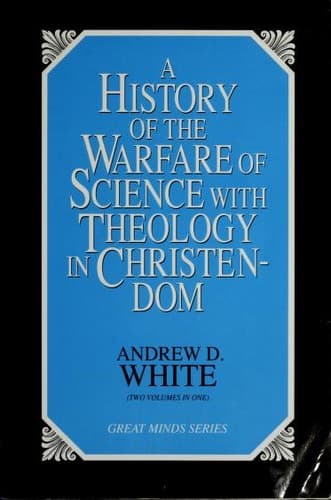
History of the Warfare of Science with Theology in ChristendomWhite, Andrew Dickson
Religion
History of the Warfare of Science with Theology in Christendom
White, Andrew Dickson
Religion and science -- History
Nor have these investigations been of a careless character. Between
the years 1851 and 1854, Mr. Horner, an extremely cautious English
geologist, sank ninety-six shafts in four rows at intervals of eight
English miles, at right angles to the Nile, in the neighbourhood of
Memphis. In these pottery was brought up from various depths, and
beneath the statue of Rameses II at Memphis from a depth of thirty-nine
feet. At the rate of the Nile deposit a careful estimate has declared
this to indicate a period of over eleven thousand years. So eminent a
German authority, in geography as Peschel characterizes objections to
such deductions as groundless. However this may be, the general results
of these investigations, taken in connection with the other results of
research, are convincing.
And, finally, as if to make assurance doubly sure, a series of
archaeologists of the highest standing, French, German, English, and
American, have within the past twenty years discovered relics of a
savage period, of vastly earlier date than the time of Mena, prevailing
throughout Egypt. These relics have been discovered in various parts of
the country, from Cairo to Luxor, in great numbers. They are the same
sort of prehistoric implements which prove to us the early existence of
man in so many other parts of the world at a geological period so remote
that the figures given by our sacred chronologists are but trivial. The
last and most convincing of these discoveries, that of flint implements
in the drift, far down below the tombs of early kings at Thebes, and
upon high terraces far above the present bed of the Nile, will be
referred to later.
But it is not in Egypt alone that proofs are found of the utter
inadequacy of the entire chronological system derived from our sacred
books. These results of research in Egypt are strikingly confirmed by
research in Assyria and Babylonia. Prof. Sayce exhibits various proofs
of this. To use his own words regarding one of these proofs: "On the
shelves of the British Museum you may see huge sun-dried bricks, on
which are stamped the names and titles of kings who erected or repaired
the temples where they have been found.... They must... have reigned
before the time when, according to the margins of our Bibles, the Flood
of Noah was covering the earth and reducing such bricks as these to
their primeval slime."
Public-domain text, read in full here on John Shaqi.
Reviews
Reviews
No reviews yet
Be the first to share your thoughts on this work.
Elsewhere in the archive
Join the Discussion
Join the discussion
Sign in to leave a comment or review.
Sign InorCreate an account