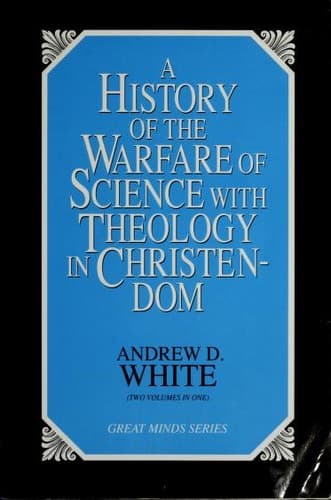
History of the Warfare of Science with Theology in ChristendomWhite, Andrew Dickson
Religion
History of the Warfare of Science with Theology in Christendom
White, Andrew Dickson
Religion and science -- History
Naturally these beliefs were brought into the Christian mythology and
adapted to it. During the Middle Ages many of these well-wrought stones
were venerated as weapons, which during the "war in heaven" had been
used in driving forth Satan and his hosts; hence in the eleventh century
an Emperor of the East sent to the Emperor of the West a "heaven axe";
and in the twelfth century a Bishop of Rennes asserted the value of
thunder-stones as a divinely-appointed means of securing success in
battle, safety on the sea, security against thunder, and immunity from
unpleasant dreams. Even as late as the seventeenth century a French
ambassador brought a stone hatchet, which still exists in the museum at
Nancy, as a present to the Prince-Bishop of Verdun, and claimed for it
health-giving virtues.
In the last years of the sixteenth century Michael Mercati tried to
prove that the "thunder-stones" were weapons or implements of early
races of men; but from some cause his book was not published until the
following century, when other thinkers had begun to take up the same
idea, and then it had to contend with a theory far more accordant with
theologic modes of reasoning in science. This was the theory of the
learned Tollius, who in 1649 told the world that these chipped or
smoothed stones were "generated in the sky by a fulgurous exhalation
conglobed in a cloud by the circumposed humour."
But about the beginning of the eighteenth century a fact of great
importance was quietly established. In the year 1715 a large pointed
weapon of black flint was found in contact with the bones of an
elephant, in a gravel bed near Gray's Inn Lane, in London. The world in
general paid no heed to this: if the attention of theologians was called
to it, they dismissed it summarily with a reference to the Deluge of
Noah; but the specimen was labelled, the circumstances regarding it were
recorded, and both specimen and record carefully preserved.
In 1723 Jussieu addressed the French Academy on The Origin and Uses of
Thunder-stones. He showed that recent travellers from various parts of
the world had brought a number of weapons and other implements of stone
to France, and that they were essentially similar to what in Europe had
been known as "thunder-stones." A year later this fact was clinched into
the scientific mind of France by the Jesuit Lafitau, who published
a work showing the similarity between the customs of aborigines then
existing in other lands and those of the early inhabitants of Europe. So
began, in these works of Jussieu and Lafitau, the science of Comparative
Ethnography.
But it was at their own risk and peril that thinkers drew from these
discoveries any conclusions as to the antiquity of man. Montesquieu,
having ventured to hint, in an early edition of his Persian Letters,
that the world might be much older than had been generally supposed,
was soon made to feel danger both to his book and to himself, so that in
succeeding editions he suppressed the passage.
Public-domain text, read in full here on John Shaqi.
Reviews
Reviews
No reviews yet
Be the first to share your thoughts on this work.
Elsewhere in the archive
Join the Discussion
Join the discussion
Sign in to leave a comment or review.
Sign InorCreate an account