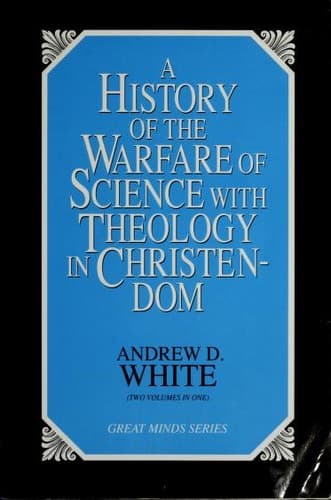
History of the Warfare of Science with Theology in ChristendomWhite, Andrew Dickson
Religion
History of the Warfare of Science with Theology in Christendom
White, Andrew Dickson
Religion and science -- History
At the Reformation the vast authority of Luther was thrown in favour
of the literal acceptance of Scripture as the main source of natural
science. The allegorical and mystical interpretations of earlier
theologians he utterly rejected. "Why," he asks, "should Moses use
allegory when he is not speaking of allegorical creatures or of an
allegorical world, but of real creatures and of a visible world, which
can be seen, felt, and grasped? Moses calls things by their right names,
as we ought to do.... I hold that the animals took their being at once
upon the word of God, as did also the fishes in the sea."
Not less explicit in his adherence to the literal account of creation
given in Genesis was Calvin. He warns those who, by taking another view
than his own, "basely insult the Creator, to expect a judge who will
annihilate them." He insists that all species of animals were created
in six days, each made up of an evening and a morning, and that no new
species has ever appeared since. He dwells on the production of birds
from the water as resting upon certain warrant of Scripture, but adds,
"If the question is to be argued on physical grounds, we know that
water is more akin to air than the earth is." As to difficulties in the
scriptural account of creation, he tells us that God "wished by these to
give proofs of his power which should fill us with astonishment."
The controlling minds in the Roman Church steadfastly held this view. In
the seventeenth century Bossuet threw his vast authority in its favour,
and in his Discourse on Universal History, which has remained the
foundation not only of theological but of general historical teaching
in France down to the present republic, we find him calling attention to
what he regards as the culminating act of creation, and asserting that,
literally, for the creation of man earth was used, and "the finger of
God applied to corruptible matter."
The Protestant world held this idea no less persistently. In the
seventeenth century Dr. John Lightfoot, Vice-Chancellor of the
University of Cambridge, the great rabbinical scholar of his time,
attempted to reconcile the two main legends in Genesis by saying that of
the "clean sort of beasts there were seven of every kind created, three
couples for breeding and the odd one for Adam's sacrifice on his fall,
which God foresaw"; and that of unclean beasts only one couple was
created.
Public-domain text, read in full here on John Shaqi.
Reviews
Reviews
No reviews yet
Be the first to share your thoughts on this work.
Join the Discussion
Join the discussion
Sign in to leave a comment or review.
Sign InorCreate an account