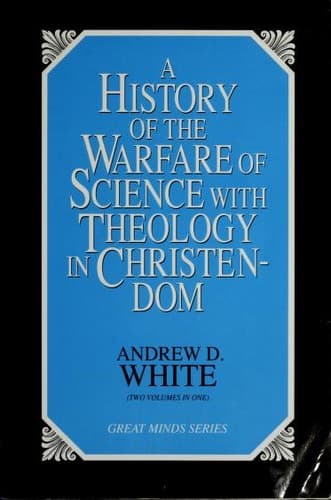
History of the Warfare of Science with Theology in ChristendomWhite, Andrew Dickson
Religion
History of the Warfare of Science with Theology in Christendom
White, Andrew Dickson
Religion and science -- History
So literal was this whole conception of the work of creation that in
these days it can scarcely be imagined. The Almighty was represented
in theological literature, in the pictured Bibles, and in works of art
generally, as a sort of enlarged and venerable Nuremberg toymaker. At
times the accounts in Genesis were illustrated with even more literal
exactness; thus, in connection with a well-known passage in the sacred
text, the Creator was shown as a tailor, seated, needle in hand,
diligently sewing together skins of beasts into coats for Adam and Eve.
Such representations presented no difficulties to the docile minds of
the Middle Ages and the Reformation period; and in the same spirit, when
the discovery of fossils began to provoke thought, these were declared
to be "models of his works approved or rejected by the great Artificer,"
"outlines of future creations," "sports of Nature," or "objects placed
in the strata to bring to naught human curiosity"; and this kind of
explanation lingered on until in our own time an eminent naturalist,
in his anxiety to save the literal account in Genesis, has urged that
Jehovah tilted and twisted the strata, scattered the fossils through
them, scratched the glacial furrows upon them, spread over them
the marks of erosion by water, and set Niagara pouring--all in an
instant--thus mystifying the world "for some inscrutable purpose, but
for his own glory."(12)
(12) For the citation from Lactantius, see Divin. Instit., lib. ii, cap.
xi, in Migne, tome vi, pp. 311, 312; for St. Augustine's great phrase,
see the De Genes. ad litt., ii, 5; for St. Ambrose, see lib. i, cap. ii;
for Vincent of Beauvais, see the Speculum Naturale, lib. i, cap. ii, and
lib. ii, cap. xv and xxx; also Bourgeat, Etudes sur Vincent de Beauvais,
Paris, 1856, especially chaps. vii, xii, and xvi; for Cardinal d"ailly,
see the Imago Mundi, and for Reisch, see the various editions of the
Margarita Philosophica; for Luther's statements, see Luther's Schriften,
ed. Walch, Halle, 1740, Commentary on Genesis, vol. i; for Calvin's view
of the creation of the animals, including the immutability of Species,
see the Comm. in Gen., tome i of his Opera omnia, Amst., 1671, cap. i,
v, xx, p. 5, also cap. ii, v, ii, p. 8, and elsewhere; for Bossuet, see
his Discours sur l'Histoire universelle (in his OEuvres, tome v, Paris,
1846); for Lightfoot, see his works, edited by Pitman, London, 1822;
for Bede, see the Hexaemeron, lib. i, in Migne, tome xci, p.21; for Mr.
Gosse'smodern defence of the literal view, see his Omphalos, London,
1857, passim.
The next important development of theological reasoning had regard to
the DIVISIONS of the animal kingdom.
Public-domain text, read in full here on John Shaqi.
Reviews
Reviews
No reviews yet
Be the first to share your thoughts on this work.
Join the Discussion
Join the discussion
Sign in to leave a comment or review.
Sign InorCreate an account