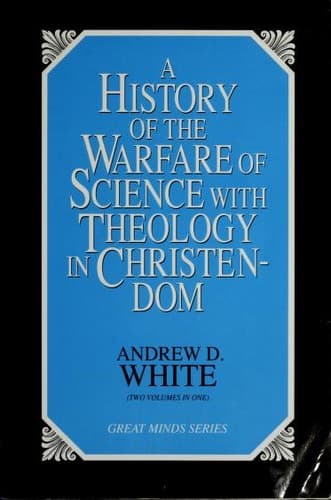
History of the Warfare of Science with Theology in ChristendomWhite, Andrew Dickson
Religion
History of the Warfare of Science with Theology in Christendom
White, Andrew Dickson
Religion and science -- History
This belief was handed down the ages as part of "the sacred deposit of
the faith" until Watson, the most prolific writer of the evangelical
reform in the eighteenth century and the standard theologian of the
evangelical party, declared: "We have no reason at all to believe
that the animal had a serpentine form in any mode or degree until its
transformation; that he was then degraded to a reptile to go upon his
belly imports, on the contrary, an entire loss and alteration of the
original form." Here, again, was a ripe result of the theologic method
diligently pursued by the strongest thinkers in the Church during nearly
two thousand years; but this "sacred deposit" also faded away when the
geologists found abundant remains of fossil serpents dating from periods
long before the appearance of man.
Troublesome questions also arose among theologians regarding animals
classed as "superfluous." St. Augustine was especially exercised
thereby. He says: "I confess I am ignorant why mice and frogs were
created, or flies and worms.... All creatures are either useful, hurtful,
or superfluous to us.... As for the hurtful creatures, we are either
punished, or disciplined, or terrified by them, so that we may not
cherish and love this life." As to the "superfluous animals," he says,
"Although they are not necessary for our service, yet the whole design
of the universe is thereby completed and finished." Luther, who followed
St. Augustine in so many other matters, declined to follow him fully in
this. To him a fly was not merely superfluous, it was noxious--sent by
the devil to vex him when reading.
Another subject which gave rise to much searching of Scripture and long
trains of theological reasoning was the difference between the creation
of man and that of other living beings.
Great stress was laid by theologians, from St. Basil and St. Augustine
to St. Thomas Aquinas and Bossuet, and from Luther to Wesley, on the
radical distinction indicated in Genesis, God having created man "in his
own image." What this statement meant was seen in the light of the later
biblical statement that "Adam begat Seth in his own likeness, after his
image."
In view of this and of well-known texts incorporated from older creation
legends into the Hebrew sacred books it came to be widely held that,
while man was directly moulded and fashioned separately by the Creator's
hand, the animals generally were evoked in numbers from the earth and
sea by the Creator's voice.
Public-domain text, read in full here on John Shaqi.
Reviews
Reviews
No reviews yet
Be the first to share your thoughts on this work.
Join the Discussion
Join the discussion
Sign in to leave a comment or review.
Sign InorCreate an account