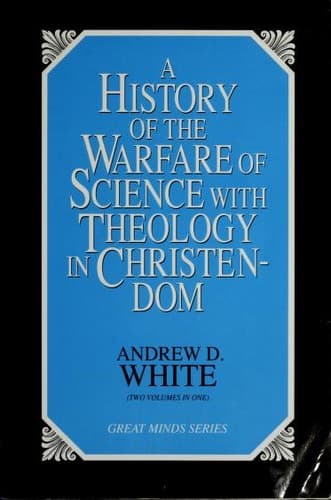
History of the Warfare of Science with Theology in ChristendomWhite, Andrew Dickson
Religion
History of the Warfare of Science with Theology in Christendom
White, Andrew Dickson
Religion and science -- History
A question now arose naturally as to the DISTINCTIONS OF SPECIES among
animals. The vast majority of theologians agreed in representing all
animals as created "in the beginning," and named by Adam, preserved in
the ark, and continued ever afterward under exactly the same species.
This belief ripened into a dogma. Like so many other dogmas in the
Church, Catholic and Protestant, its real origins are to be found rather
in pagan philosophy than in the Christian Scriptures; it came far more
from Plato and Aristotle than from Moses and St. Paul. But this was not
considered: more and more it became necessary to believe that each
and every difference of species was impressed by the Creator "in the
beginning," and that no change had taken place or could have taken place
since.
Some difficulties arose here and there as zoology progressed and
revealed ever-increasing numbers of species; but through the Middle
Ages, and indeed long after the Reformation, these difficulties were
easily surmounted by making the ark of Noah larger and larger, and
especially by holding that there had been a human error in regard to its
measurement.(13)
(13) For St. Augustine, see De Genesis and De Trinitate, passim; for
Bede, see Hexaemeron, lib. i, in Migne, tome xci, pp. 21, 36-38, 42; and
De Sex Dierum Criatione, in Migne, tome xciii, p. 215; for Peter Lombard
on "noxious animals," see his Sententiae, lib. ii, dist. xv, 3, Migne,
tome cxcii, p. 682; for Wesley, Clarke, and Watson, see quotations from
them and notes thereto in my chapter on Geology; for St. Augustine
on "superfluous animals," see the De Genesi, lib. i, cap. xvi, 26; on
Luther's view of flies, see the Table Talk and his famous utterance,
"Odio muscas quia sunt imagines diaboli et hoereticorum"; for the agency
of Aristotle and Plato in fastening the belief in the fixity of species
into Christian theology, see Sachs, Geschichte der Botanik, Munchen,
1875, p. 107 and note, also p. 113.
But naturally there was developed among both ecclesiastics and laymen
a human desire to go beyond these special points in the history of
animated beings--a desire to know what the creation really IS.
Current legends, stories, and travellers' observations, poor as they
were, tended powerfully to stimulate curiosity in this field.
Three centuries before the Christian era Aristotle had made the
first really great attempt to satisfy this curiosity, and had begun
a development of studies in natural history which remains one of the
leading achievements in the story of our race.
Public-domain text, read in full here on John Shaqi.
Reviews
Reviews
No reviews yet
Be the first to share your thoughts on this work.
Join the Discussion
Join the discussion
Sign in to leave a comment or review.
Sign InorCreate an account