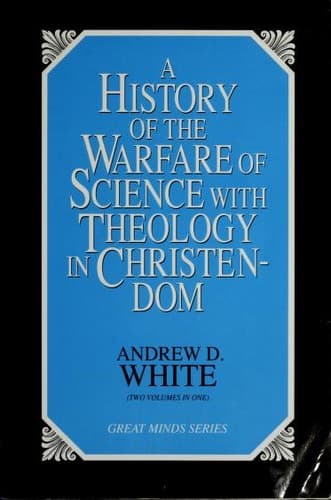
History of the Warfare of Science with Theology in ChristendomWhite, Andrew Dickson
Religion
History of the Warfare of Science with Theology in Christendom
White, Andrew Dickson
Religion and science -- History
Here and there among men who were free from church control we have work
of a better sort. In the twelfth and thirteenth centuries Abd Allatif
made observations upon the natural history of Egypt which showed a truly
scientific spirit, and the Emperor Frederick II attempted to promote a
more fruitful study of Nature; but one of these men was abhorred as a
Mussulman and the other as an infidel. Far more in accordance with the
spirit of the time was the ecclesiastic Giraldus Cambrensis, whose book
on the topography of Ireland bestows much attention upon the animals
of the island, and rarely fails to make each contribute an appropriate
moral. For example, he says that in Ireland "eagles live for so many
ages that they seem to contend with eternity itself; so also the saints,
having put off the old man and put on the new, obtain the blessed fruit
of everlasting life." Again, he tells us: "Eagles often fly so high that
their wings are scorched by the sun; so those who in the Holy Scriptures
strive to unravel the deep and hidden secrets of the heavenly mysteries,
beyond what is allowed, fall below, as if the wings of the presumptuous
imaginations on which they are borne were scorched."
In one of the great men of the following century appeared a gleam of
healthful criticism: Albert the Great, in his work on the animals,
dissents from the widespread belief that certain birds spring from trees
and are nourished by the sap, and also from the theory that some are
generated in the sea from decaying wood.
But it required many generations for such scepticism to produce much
effect, and we find among the illustrations in an edition of Mandeville
published just before the Reformation not only careful accounts but
pictured representations both of birds and of beasts produced in the
fruit of trees.(15)
(15) For Giraldus Cambrensis, see the edition in the Bohn Library,
London, 1863, p. 30; for the Abd Allatif and Frederick II, see Hoefer,
as above; for Albertus Magnus, see the De Animalibus, lib. xxiii; for
the illustrations in Mandeville, see the Strasburg edition, 1484;
for the history of the myth of the tree which produces birds, see Max
Muller's lectures on the Science of Language, second series, lect. xii.
This general employment of natural science for pious purposes went on
after the Reformation. Luther frequently made this use of it, and his
example controlled his followers. In 1612, Wolfgang Franz, Professor of
Theology at Luther's university, gave to the world his sacred history of
animals, which went through many editions. It contained a very ingenious
classification, describing "natural dragons," which have three rows of
teeth to each jaw, and he piously adds, "the principal dragon is the
Devil."
Near the end of the same century, Father Kircher, the great Jesuit
professor at Rome, holds back the sceptical current, insists upon the
orthodox view, and represents among the animals entering the ark sirens
and griffins.
Public-domain text, read in full here on John Shaqi.
Reviews
Reviews
No reviews yet
Be the first to share your thoughts on this work.
Elsewhere in the archive
Join the Discussion
Join the discussion
Sign in to leave a comment or review.
Sign InorCreate an account