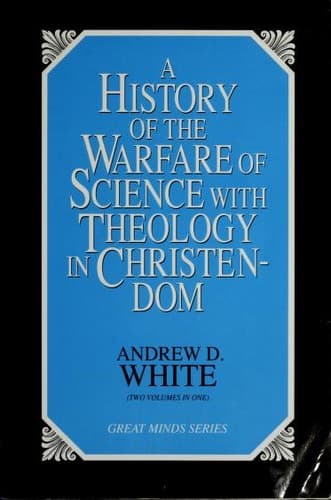
History of the Warfare of Science with Theology in ChristendomWhite, Andrew Dickson
Religion
History of the Warfare of Science with Theology in Christendom
White, Andrew Dickson
Religion and science -- History
Yet even among theologians we note here and there a sceptical spirit
in natural science. Early in the same seventeenth century Eugene
Roger published his Travels in Palestine. As regards the utterances
of Scripture he is soundly orthodox: he prefaces his work with a map
showing, among other important points referred to in biblical history,
the place where Samson slew a thousand Philistines with the jawbone of
an ass, the cavern which Adam and Eve inhabited after their expulsion
from paradise, the spot where Balaam's ass spoke, the place where Jacob
wrestled with the angel, the steep place down which the swine possessed
of devils plunged into the sea, the position of the salt statue which
was once Lot's wife, the place at sea where Jonah was swallowed by
the whale, and "the exact spot where St. Peter caught one hundred and
fifty-three fishes."
As to natural history, he describes and discusses with great theological
acuteness the basilisk. He tells us that the animal is about a foot and
a half long, is shaped like a crocodile, and kills people with a single
glance. The one which he saw was dead, fortunately for him, since in
the time of Pope Leo IV--as he tells us--one appeared in Rome and killed
many people by merely looking at them; but the Pope destroyed it with
his prayers and the sign of the cross. He informs us that Providence
has wisely and mercifully protected man by requiring the monster to cry
aloud two or three times whenever it leaves its den, and that the divine
wisdom in creation is also shown by the fact that the monster is obliged
to look its victim in the eye, and at a certain fixed distance, before
its glance can penetrate the victim's brain and so pass to his heart.
He also gives a reason for supposing that the same divine mercy has
provided that the crowing of a cock will kill the basilisk.
Yet even in this good and credulous missionary we see the influence of
Bacon and the dawn of experimental science; for, having been told many
stories regarding the salamander, he secured one, placed it alive upon
the burning coals, and reports to us that the legends concerning its
power to live in the fire are untrue. He also tried experiments with
the chameleon, and found that the stories told of it were to be received
with much allowance: while, then, he locks up his judgment whenever he
discusses the letter of Scripture, he uses his mind in other things much
after the modern method.
Public-domain text, read in full here on John Shaqi.
Reviews
Reviews
No reviews yet
Be the first to share your thoughts on this work.
Elsewhere in the archive
Join the Discussion
Join the discussion
Sign in to leave a comment or review.
Sign InorCreate an account