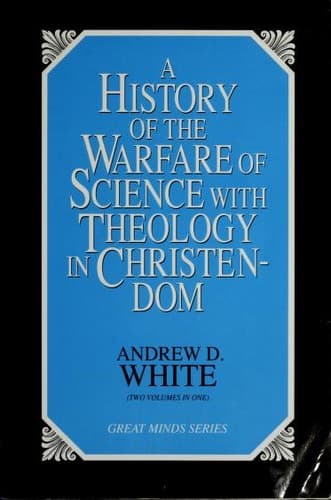
History of the Warfare of Science with Theology in ChristendomWhite, Andrew Dickson
Religion
History of the Warfare of Science with Theology in Christendom
White, Andrew Dickson
Religion and science -- History
About the middle of the seventeenth century came a great victory of
the scientific over the theologic method. At that time Francesco Redi
published the results of his inquiries into the doctrine of spontaneous
generation. For ages a widely accepted doctrine had been that water,
filth, and carrion had received power from the Creator to generate
worms, insects, and a multitude of the smaller animals; and this
doctrine had been especially welcomed by St. Augustine and many of the
fathers, since it relieved the Almighty of making, Adam of naming, and
Noah of living in the ark with these innumerable despised species.
But to this fallacy Redi put an end. By researches which could not be
gainsaid, he showed that every one of these animals came from an egg;
each, therefore, must be the lineal descendant of an animal created,
named, and preserved from "the beginning."
Similar work went on in England, but under more distinctly theological
limitations. In the same seventeenth century a very famous and popular
English book was published by the naturalist John Ray, a fellow of the
Royal Society, who produced a number of works on plants, fishes, and
birds; but the most widely read of all was entitled The Wisdom of God
manifested in the Works of Creation. Between the years 1691 and 1827 it
passed through nearly twenty editions.
Ray argued the goodness and wisdom of God from the adaptation of the
animals not only to man's uses but to their own lives and surroundings.
In the first years of the eighteenth century Dr. Nehemiah Grew, of the
Royal Society, published his Cosmologia Sacra to refute anti-scriptural
opinions by producing evidences of creative design. Discussing "the ends
of Providence," he says, "A crane, which is scurvy meat, lays but two
eggs in the year, but a pheasant and partridge, both excellent meat, lay
and hatch fifteen or twenty." He points to the fact that "those of value
which lay few at a time sit the oftener, as the woodcock and the dove."
He breaks decidedly from the doctrine that noxious things in Nature are
caused by sin, and shows that they, too, are useful; that, "if nettles
sting, it is to secure an excellent medicine for children and cattle";
that, "if the bramble hurts man, it makes all the better hedge"; and
that, "if it chances to prick the owner, it tears the thief." "Weasels,
kites, and other hurtful animals induce us to watchfulness; thistles and
moles, to good husbandry; lice oblige us to cleanliness in our
bodies, spiders in our houses, and the moth in our clothes." This very
optimistic view, triumphing over the theological theory of noxious
animals and plants as effects of sin, which prevailed with so much force
from St. Augustine to Wesley, was developed into nobler form during the
century by various thinkers, and especially by Archdeacon Paley, whose
Natural Theology exercised a powerful influence down to recent
times. The same tendency appeared in other countries, though various
Public-domain text, read in full here on John Shaqi.
Reviews
Reviews
No reviews yet
Be the first to share your thoughts on this work.
Elsewhere in the archive
Join the Discussion
Join the discussion
Sign in to leave a comment or review.
Sign InorCreate an account