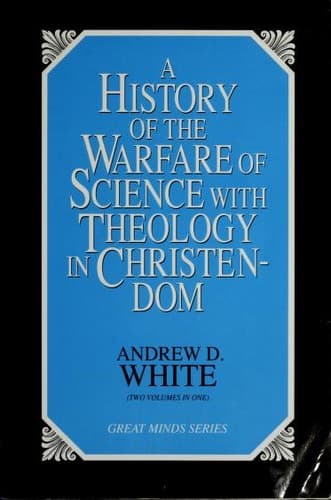
History of the Warfare of Science with Theology in ChristendomWhite, Andrew Dickson
Religion
History of the Warfare of Science with Theology in Christendom
White, Andrew Dickson
Religion and science -- History
in this life 'know not God and obey not the gospel of his Son.'"
Fortunately, at about the time when Darwin's Descent of Man was
published, there had come into Princeton University "deus ex machina"
in the person of Dr. James McCosh. Called to the presidency, he at once
took his stand against teachings so dangerous to Christianity as those
of Drs. Hodge, Duffield, and their associates. In one of his personal
confidences he has let us into the secret of this matter. With that hard
Scotch sense which Thackeray had applauded in his well-known verses, he
saw that the most dangerous thing which could be done to Christianity
at Princeton was to reiterate in the university pulpit, week after week,
solemn declarations that if evolution by natural selection, or indeed
evolution at all, be true, the Scriptures are false. He tells us that he
saw that this was the certain way to make the students unbelievers;
he therefore not only checked this dangerous preaching but preached an
opposite doctrine. With him began the inevitable compromise, and, in
spite of mutterings against him as a Darwinian, he carried the day.
Whatever may be thought of his general system of philosophy, no one can
deny his great service in neutralizing the teachings of his predecessors
and colleagues--so dangerous to all that is essential in Christianity.
Other divines of strong sense in other parts of the country began to
take similar ground--namely, that men could be Christians and at the
same time Darwinians. There appeared, indeed, here and there, curious
discrepancies: thus in 1873 the Monthly Religious Magazine of Boston
congratulated its readers that the Rev. Mr. Burr had "demolished the
evolution theory, knocking the breath of life out of it and throwing it
to the dogs." This amazing performance by the Rev. Mr. Burr was repeated
in a very striking way by Bishop Keener before the Oecumenical Council
of Methodism at Washington in 1891. In what the newspapers described
as an "admirable speech," he refuted evolution doctrines by saying that
evolutionists had "only to make a journey of twelve hours from the place
where he was then standing to find together the bones of the muskrat,
the opossum, the coprolite, and the ichthyosaurus." He asserted that
Agassiz--whom the good bishop, like so many others, seemed to think
an evolutionist--when he visited these beds near Charleston, declared:
"These old beds have set me crazy; they have destroyed the work of a
lifetime." And the Methodist prelate ended by saying: "Now, gentlemen,
brethren, take these facts home with you; get down and look at them.
This is the watch that was under the steam hammer--the doctrine of
evolution; and this steam hammer is the wonderful deposit of the Ashley
beds." Exhibitions like these availed little. While the good bishop amid
vociferous applause thus made comically evident his belief that Agassiz
was a Darwinian and a coprolite an animal, scientific men were recording
Public-domain text, read in full here on John Shaqi.
History of the Warfare of Science with Theology in Christendom — John Shaqi
Reviews
Reviews
No reviews yet
Be the first to share your thoughts on this work.
Elsewhere in the archive
Join the Discussion
Join the discussion
Sign in to leave a comment or review.
Sign InorCreate an account