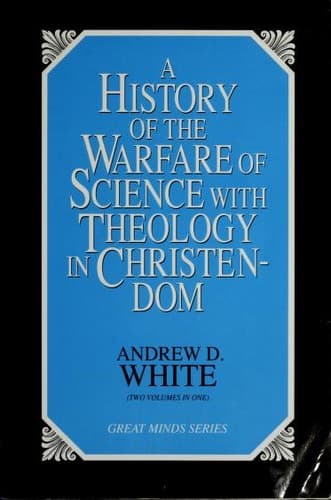
History of the Warfare of Science with Theology in ChristendomWhite, Andrew Dickson
Religion
History of the Warfare of Science with Theology in Christendom
White, Andrew Dickson
Religion and science -- History
To the honour of the Church of England it should be recorded that a
considerable number of her truest men opposed such utterances as these,
and that one of them--Farrar, Archdeacon of Westminster--made a protest
worthy to be held in perpetual remembrance. While confessing his own
inability to accept fully the new scientific belief, he said: "We should
consider it disgraceful and humiliating to try to shake it by an
ad captandum argument, or by a clap-trap platform appeal to the
unfathomable ignorance and unlimited arrogance of a prejudiced assembly.
We should blush to meet it with an anathema or a sneer."
All opposition had availed nothing; Darwin's work and fame were secure.
As men looked back over his beautiful life--simple, honest, tolerant,
kindly--and thought upon his great labours in the search for truth, all
the attacks faded into nothingness.
There were indeed some dark spots, which as time goes on appear darker.
At Trinity College, Cambridge, Whewell, the "omniscient," author of the
History of the Inductive Sciences, refused to allow a copy of the Origin
of Species to be placed in the library. At multitudes of institutions
under theological control--Protestant as well as Catholic--attempts were
made to stamp out or to stifle evolutionary teaching. Especially was
this true for a time in America, and the case of the American College
at Beyrout, where nearly all the younger professors were dismissed for
adhering to Darwin's views, is worthy of remembrance. The treatment of
Dr. Winchell at the Vanderbilt University in Tennessee showed the same
spirit; one of the truest of men, devoted to science but of deeply
Christian feeling, he was driven forth for views which centred in the
Darwinian theory.
Still more striking was the case of Dr. Woodrow. He had, about 1857,
been appointed to a professorship of Natural Science as connected with
Revealed Religion, in the Presbyterian Seminary at Columbia, South
Carolina. He was a devoted Christian man, and his training had led him
to accept the Presbyterian standards of faith. With great gifts
for scientific study he visited Europe, made a most conscientious
examination of the main questions under discussion, and adopted the
chief points in the doctrine of evolution by natural selection. A
struggle soon began. A movement hostile to him grew more and more
determined, and at last, in spite of the efforts made in his behalf by
the directors of the seminary and by a large and broad-minded minority
in the representative bodies controlling it, an orthodox storm, raised
by the delegates from various Presbyterian bodies, drove him from
his post. Fortunately, he was received into a professorship at the
University of South Carolina, where he has since taught with more power
than ever before.
Public-domain text, read in full here on John Shaqi.
Reviews
Reviews
No reviews yet
Be the first to share your thoughts on this work.
Elsewhere in the archive
Join the Discussion
Join the discussion
Sign in to leave a comment or review.
Sign InorCreate an account