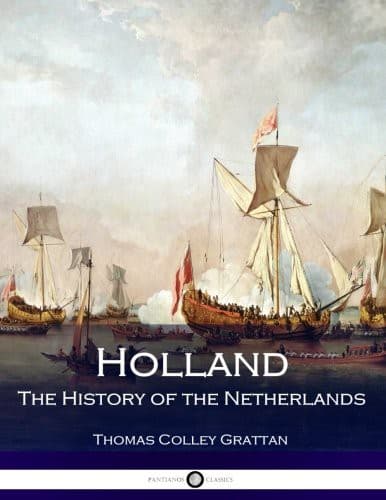
Holland: The History of the NetherlandsGrattan, Thomas Colley
History
Holland: The History of the Netherlands
Grattan, Thomas Colley
Netherlands -- History
All the services just related in the common cause of the country
and the king produced no effect on the vindictive spirit of the
latter. Neither the lapse of time, the proofs of repentance, nor
the fulfilment of their duty, could efface the hatred excited
by a conscientious opposition to even one design of despotism.
Philip was ill at Segovia when he received accounts of the excesses
of the image-breakers, and of the convention concluded with the
heretics. Despatches from the stadtholderess, with private advice
from Viglius, Egmont, Mansfield, Meghem, De Berlaimont, and others,
gave him ample information as to the real state of things, and they
thus strove to palliate their having acceded to the convention. The
emperor even wrote to his royal nephew, imploring him to treat his
wayward subjects with moderation, and offered his mediation between
them. Philip, though severely suffering, gave great attention to
the details of this correspondence, which he minutely examined,
and laid before his council of state, with notes and observations
taken by himself. But he took special care to send to them only
such parts as he chose them to be well informed upon; his natural
distrust not suffering him to have any confidential communication
with men.
Again the Spanish council appears to have interfered between
the people of the Netherlands and the enmity of the monarch;
and the offered mediation of the emperor was recommended to his
acceptance, to avoid the appearance of a forced concession to
the popular will. Philip was also strongly urged to repair to
the scene of the disturbances; and a main question of debate was,
whether he should march at the head of an army or confide himself
to the loyalty and good faith of his Belgian subjects. But the
indolence or the pride of Philip was too strong to admit of his
taking so vigorous a measure; and all these consultations ended
in two letters to the stadtholderess. In the first he declared
his firm intention to visit the Netherlands in person; refused
to convoke the states-general; passed in silence the treaties
concluded with the Protestants and the confederates; and finished
by a declaration that he would throw himself wholly on the fidelity
of the country. In his second letter, meant for the stadtholderess
alone, he authorized her to assemble the states-general if public
opinion became too powerful for resistance, but on no account
to let it transpire that he had under any circumstances given
his consent.
Public-domain text, read in full here on John Shaqi.
Reviews
Reviews
No reviews yet
Be the first to share your thoughts on this work.
Elsewhere in the archive
Join the Discussion
Join the discussion
Sign in to leave a comment or review.
Sign InorCreate an account