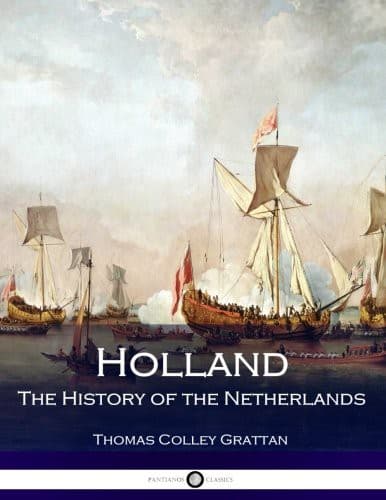
Holland: The History of the NetherlandsGrattan, Thomas Colley
History
Holland: The History of the Netherlands
Grattan, Thomas Colley
Netherlands -- History
This total dispersion of the confederacy brought all the towns
of Holland into obedience to the king. But the emigration which
immediately commenced threatened the country with ruin. England
and Germany swarmed with Dutch and Belgian refugees; and all the
efforts of the stadtholderess could not restrain the thousands
that took to flight. She was not more successful in her attempts to
influence the measures of the king. She implored him, in repeated
letters, to abandon his design of sending a foreign army into
the country, which she represented as being now quite reduced
to submission and tranquillity. She added that the mere report
of this royal invasion (so to call it) had already deprived the
Netherlands of many thousands of its best inhabitants; and that
the appearance of the troops would change it into a desert. These
arguments, meant to dissuade, were the very means of encouraging
Philip in his design. He conceived his project to be now ripe
for the complete suppression of freedom; and Alva soon began
his march.
On the 5th of May, 1567, this celebrated captain, whose reputation
was so quickly destined to sink into the notoriety of an executioner,
began his memorable march; and on the 22d of August he, with
his two natural sons, and his veteran army consisting of about
fifteen thousand men, arrived at the walls of Brussels. The
discipline observed on this march was a terrible forewarning to
the people of the Netherlands of the influence of the general and
the obedience of the troops. They had little chance of resistance
against such soldiers so commanded.
Several of the Belgian nobility went forward to meet Alva, to
render him the accustomed honors, and endeavor thus early to
gain his good graces. Among them was the infatuated Egmont, who
made a present to Alva of two superb horses, which the latter
received with a disdainful air of condescension. Alva's first
care was the distribution of his troops--several thousands of
whom were placed in Antwerp, Ghent, and other important towns,
and the remainder reserved under his own immediate orders at
Brussels. His approach was celebrated by universal terror; and
his arrival was thoroughly humiliating to the duchess of Parma.
He immediately produced his commission as commander-in-chief
of the royal armies in the Netherlands; but he next showed her
another, which confided to him powers infinitely more extended
than any Marguerite herself had enjoyed, and which proved to her
that the almost sovereign power over the country was virtually
vested in him.
Public-domain text, read in full here on John Shaqi.
Reviews
Reviews
No reviews yet
Be the first to share your thoughts on this work.
Elsewhere in the archive
Join the Discussion
Join the discussion
Sign in to leave a comment or review.
Sign InorCreate an account