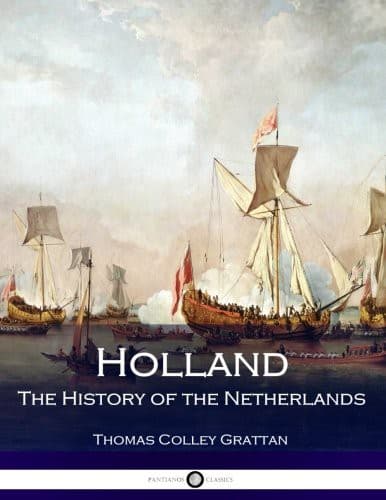
Holland: The History of the NetherlandsGrattan, Thomas Colley
History
Holland: The History of the Netherlands
Grattan, Thomas Colley
Netherlands -- History
Requesens performed all that depended on him, to gain the confidence
of the people. He caused Alva's statue to be removed; and hoped
to efface the memory of the tyrant by dissolving the Council of
Blood and abandoning the obnoxious taxes which their inventor
had suspended rather than abolished. A general amnesty was also
promulgated against the revolted provinces; they received it
with contempt and defiance. Nothing then was left to Requesens
but to renew the war; and this he found to be a matter of no
easy execution. The finances were in a state of the greatest
confusion; and the Spanish troops were in many places seditious,
in some openly mutinous, Alva having left large arrears of pay
due to almost all, notwithstanding the immense amount of his
pillage and extortion. Middleburg, which had long sustained a
siege against all the efforts of the patriots, was now nearly
reduced by famine, notwithstanding the gallant efforts of its
governor, Mondragon. Requesens turned his immediate attention
to the relief of this important place; and he soon assembled,
at Antwerp and Berg-op-Zoom, a fleet of sixty vessels for that
purpose. But Louis Boisot, admiral of Zealand, promptly repaired
to attack this force; and after a severe action he totally defeated
it, and killed De Glimes, one of its admirals, under the eyes of
Requesens himself, who, accompanied by his suite, stood during
the whole affair on the dike of Schakerloo. This action took place
the 29th of January, 1574; and, on the 19th of February following,
Middleburg surrendered, after a resistance of two years. The Prince
of Orange granted such conditions as were due to the bravery of
the governor; and thus set an example of generosity and honor
which greatly changed the complexion of the war. All Zealand was
now free; and the intrepid Admiral Boisot gained another victory
on the 30th of May--destroying several of the Spanish vessels, and
taking some others, with their Admiral Von Haemstede. Frequent
naval enterprises were also undertaken against the frontiers of
Flanders; and while the naval forces thus harassed the enemy on
every vulnerable point, the unfortunate provinces of the interior
were ravaged by the mutinous and revolted Spaniards, and by the
native brigands, who pillaged both royalists and patriots with
atrocious impartiality.
To these manifold evils was now added one more terrible, in the
appearance of the plague, which broke out at Ghent in the month
of October, and devastated a great part of the Netherlands; not,
however, with that violence with which it rages in more southern
climates.
Public-domain text, read in full here on John Shaqi.
Reviews
Reviews
No reviews yet
Be the first to share your thoughts on this work.
Elsewhere in the archive
Join the Discussion
Join the discussion
Sign in to leave a comment or review.
Sign InorCreate an account