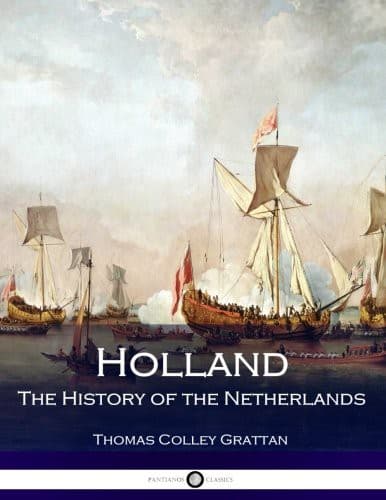
Holland: The History of the NetherlandsGrattan, Thomas Colley
History
Holland: The History of the Netherlands
Grattan, Thomas Colley
Netherlands -- History
On the day appointed, the congress opened its sittings; and rapidly
arriving at the termination of its important object, the celebrated
treaty known by the title of "The Pacification of Ghent" was
published on the 8th of November, to the sound of bells and trumpets;
while the ceremony was rendered still more imposing by the thunder
of the artillery which battered the walls of the besieged citadel.
It was even intended to have delivered a general assault against the
place at the moment of the proclamation; but the mutineers demanded
a capitulation and finally surrendered three days afterward. It
was the wife of the famous Mondragon who commanded the place
in her husband's absence; and by her heroism gave a new proof
of the capability of the sex to surpass the limits which nature
seems to have fixed for their conduct.
The Pacification contained twenty-five articles. Among others,
it was agreed:
That a full amnesty should be passed for all offences whatsoever.
That the estates of Brabant, Flanders, Hainault, Artois, and
others, on the one part; the Prince of Orange, and the states of
Holland and Zealand and their associates, on the other; promised
to maintain good faith, peace, and friendship, firm and inviolable;
to mutually assist each other, at all times, in council and action;
and to employ life and fortune, above all things, to expel from
the country the Spanish soldiers and other foreigners.
That no one should be allowed to injure or insult, by word or
deed, the exercise of the Catholic religion, on pain of being
treated as a disturber of the public peace.
That the edicts against heresy and the proclamations of the duke
of Alva should be suspended.
That all confiscations, sentences, and judgments rendered since
1566 should be annulled.
That the inscriptions, monuments, and trophies erected by the
duke of Alva should be demolished.
Such were the general conditions of the treaty; the remaining
articles chiefly concerned individual interests. The promulgation
of this great charter of union, which was considered as the
fundamental law of the country, was hailed in all parts of the
Netherlands with extravagant demonstrations of joy.
CHAPTER XI
TO THE RENUNCIATION OF THE SOVEREIGNTY OF SPAIN AND THE DECLARATION
OF INDEPENDENCE
A.D. 1576--1580
Public-domain text, read in full here on John Shaqi.
Reviews
Reviews
No reviews yet
Be the first to share your thoughts on this work.
Elsewhere in the archive
Join the Discussion
Join the discussion
Sign in to leave a comment or review.
Sign InorCreate an account