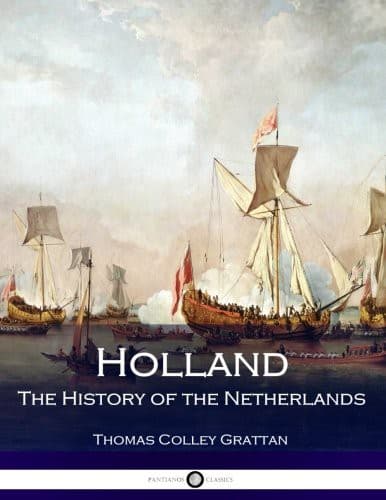
Holland: The History of the NetherlandsGrattan, Thomas Colley
History
Holland: The History of the Netherlands
Grattan, Thomas Colley
Netherlands -- History
The Prince of Orange, instead of showing the least symptom of
dissatisfaction at this underhand proceeding aimed at his personal
authority, announced his perfect approval of the nomination, and
was the foremost in recommending measures for the honor of the
archduke and the security of the country. He drew up the basis of
a treaty for Mathias's acceptance, on terms which guaranteed to the
council of state and the states-general the virtual sovereignty,
and left to the young prince little beyond the fine title which
had dazzled his boyish vanity. The Prince of Orange was appointed
his lieutenant, in all the branches of the administration, civil,
military, or financial; and the duke of Arschot, who had hoped
to obtain an entire domination over the puppet he had brought
upon the stage, saw himself totally foiled in his project, and
left without a chance or a pretext for the least increase to
his influence.
But a still greater disappointment attended this ambitious nobleman
in the very stronghold of his power. The Flemings, driven by
persecution to a state of fury almost unnatural, had, in their
antipathy to Spain, adopted a hatred against Catholicism, which had
its source only in political frenzy, while the converts imagined it
to arise from reason and conviction. Two men had taken advantage
of this state of the public mind and gained over it an unbounded
ascendency. They were Francis de Kethulle, lord of Ryhove, and
John Hembyse, who each seemed formed to realize the beau-ideal
of a factious demagogue. They had acquired supreme power over
the people of Ghent, and had at their command a body of twenty
thousand resolute and well-armed supporters. The duke of Arschot
vainly attempted to oppose his authority to that of these men;
and he on one occasion imprudently exclaimed that "he would have
them hanged, even though they were protected by the Prince of
Orange himself." The same night Ryhove summoned the leaders of
his bands; and quickly assembling a considerable force, they
repaired to the duke's hotel, made him prisoner, and, without
allowing him time to dress, carried him away in triumph. At the
same time the bishops of Bruges and Ypres, the high bailiffs of
Ghent and Courtrai, the governor of Oudenarde, and other important
magistrates, were arrested--accused of complicity with the duke,
but of what particular offence the lawless demagogues did not
deign to specify. The two tribunes immediately divided the whole
honors and authority of administration; Ryhove as military, and
Hembyse as civil, chief.
Public-domain text, read in full here on John Shaqi.
Reviews
Reviews
No reviews yet
Be the first to share your thoughts on this work.
Elsewhere in the archive
Join the Discussion
Join the discussion
Sign in to leave a comment or review.
Sign InorCreate an account