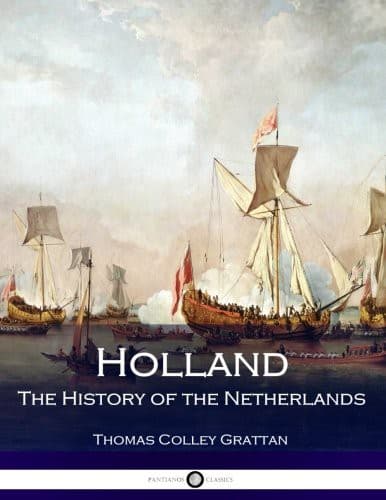
Holland: The History of the NetherlandsGrattan, Thomas Colley
History
Holland: The History of the Netherlands
Grattan, Thomas Colley
Netherlands -- History
After a sharp affair at the village of Riminants, in which the
royalists had the worst, the two armies met at Gemblours, on the
31st of January, 1578; and the prince of Parma gained a complete
victory, almost with his cavalry only, taking De Goignies prisoner,
with the whole of his artillery and baggage. The account of his
victory is almost miraculous. The royalists, if we are to credit
their most minute but not impartial historian, had only one thousand
two hundred men engaged; by whom six thousand were put to the
sword, with the loss of but twelve men and little more than an
hour's labor.
The news of this battle threw the states into the utmost
consternation. Brussels being considered insecure, the archduke
Mathias and his council retired to Antwerp; but the victors did
not feel their forces sufficient to justify an attack upon the
capital. They, however, took Louvain, Tirlemont, and several other
towns; but these conquests were of little import in comparison with
the loss of Amsterdam, which declared openly and unanimously for
the patriot cause. The states-general recovered their courage, and
prepared for a new contest. They sent deputies to the diet of Worms,
to ask succor from the princes of the empire. The count palatine
John Casimir repaired to their assistance with a considerable
force of Germans and English, all equipped and paid by Queen
Elizabeth. The duke of Alençon, brother of Henry III. of France,
hovered on the frontiers of Hainault with a respectable army;
and the cause of liberty seemed not quite desperate.
But all the various chiefs had separate interests and opposite
views; while the fanatic violence of the people of Ghent sapped
the foundations of the pacification to which the town had given
its name. The Walloon provinces, deep-rooted in their attachment
to religious bigotry, which they loved still better than political
freedom, gradually withdrew from the common cause; and without yet
openly becoming reconciled with Spain, they adopted a neutrality
which was tantamount to it. Don John was, however, deprived of
all chance of reaping any advantage from these unfortunate
dissensions. He was suddenly taken ill in his camp at Bougy;
and died, after a fortnight's suffering, on the 1st of October,
1578, in the thirty-third year of his age.
Public-domain text, read in full here on John Shaqi.
Reviews
Reviews
No reviews yet
Be the first to share your thoughts on this work.
Elsewhere in the archive
Join the Discussion
Join the discussion
Sign in to leave a comment or review.
Sign InorCreate an account