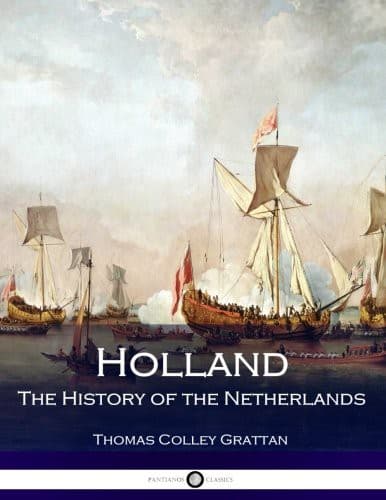
Holland: The History of the NetherlandsGrattan, Thomas Colley
History
Holland: The History of the Netherlands
Grattan, Thomas Colley
Netherlands -- History
The murder of William seemed to carry to the United Provinces
conviction of the weakness as well as the atrocity of Spain;
and the indecent joy excited among the royalists added to their
courage. An immediate council was created, composed of eighteen
members, at the head of which was unanimously placed Prince Maurice
of Nassau (who even then gave striking indications of talent and
prudence); his elder brother, the count of Beuren, now Prince
of Orange, being still kept captive in Spain. Count Hohenloe
was appointed lieutenant-general; and several other measures
were promptly adopted to consolidate the power of the infant
republic. The whole of its forces amounted but to five thousand
five hundred men. The prince of Parma had eighty thousand at
his command. With such means of carrying on his conquests, he
sat down regularly before Antwerp, and commenced the operations
of one of the most celebrated among the many memorable sieges of
those times. He completely surrounded the city with troops; placing
a large portion of his army on the left bank of the Scheldt, the
other on the right; and causing to be attacked at the same time
the two strong forts of Liefkinshoek and Lillo. Repulsed on the
latter important point, his only hope of gaining the command of
the navigation of the river, on which the success of the siege
depended, was by throwing a bridge across the stream. Neither
its great rapidity, nor its immense width, nor the want of wood
and workmen, could deter him from this vast undertaking. He was
assisted, if not guided, in all his projects on the occasion, by
Barroccio, a celebrated Italian engineer sent to him by Philip;
and the merit of all that was done ought fairly to be, at least,
divided between the general and the engineer. If enterprise and
perseverance belonged to the first, science and skill were the
portion of the latter. They first caused two strong forts to
be erected at opposite sides of the river; and adding to their
resources by every possible means, they threw forward a pier
on each side of, and far into, the stream. The stakes, driven
firmly into the bed of the river and cemented with masses of
earth and stones, were at a proper height covered with planks
and defended by parapets. These estoccades, as they were called,
reduced the river to half its original breadth; and the cannon with
which they were mounted rendered the passage extremely dangerous
to hostile vessels. But to fill up this strait a considerable
number of boats were fastened together by chain-hooks and anchors;
and being manned and armed with cannon, they were moored in the
interval between the estoccades. During these operations, a canal
was cut between the Moer and Calloo; by which means a communication
was formed with Ghent, which insured a supply of ammunition and
provisions. The works of the bridge, which was two thousand four
hundred feet in length, were constructed with such strength and
solidity that they braved the winds, the floods, and the ice
Public-domain text, read in full here on John Shaqi.
Reviews
Reviews
No reviews yet
Be the first to share your thoughts on this work.
Elsewhere in the archive
Join the Discussion
Join the discussion
Sign in to leave a comment or review.
Sign InorCreate an account