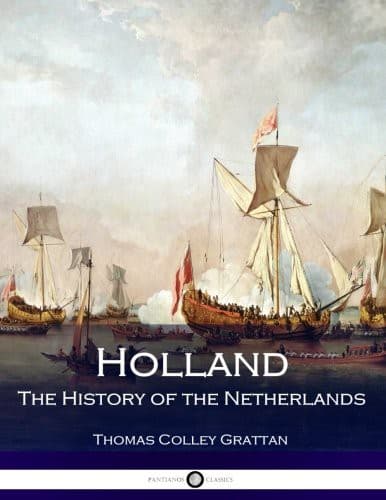
Holland: The History of the NetherlandsGrattan, Thomas Colley
History
Holland: The History of the Netherlands
Grattan, Thomas Colley
Netherlands -- History
The details of the progress and the failure of this celebrated
attempt are so thoroughly the province of English history that they
would be in this place superfluous. But it must not be forgotten
that the glory of the proud result was amply shared by the new
republic, whose existence depended on it. While Howard and Drake
held the British fleet in readiness to oppose the Spanish Armada,
that of Holland, consisting of but twenty-five ships, under the
command of Justin of Nassau, prepared to take a part in the conflict.
This gallant though illegitimate scion of the illustrious house,
whose name he upheld on many occasions, proved himself on the
present worthy of such a father as William, and such a brother as
Maurice. While the duke of Medina Sidonia, ascending the Channel
as far as Dunkirk, there expected the junction of the duke of
Parma with his important reinforcement, Justin of Nassau, by a
constant activity, and a display of intrepid talent, contrived
to block up the whole expected force in the ports of Flanders
from Lillo to Dunkirk. The duke of Parma found it impossible
to force a passage on any one point; and was doomed to the
mortification of knowing that the attempt was frustrated, and the
whole force of Spain frittered away, discomfited, and disgraced,
from the want of a co-operation, which he could not, however,
reproach himself for having withheld. The issue of the memorable
expedition, which cost Spain years of preparation, thousands
of men, and millions or treasure, was received in the country
which sent it forth with consternation and rage. Philip alone
possessed or affected an apathy which he covered with a veil
of mock devotion that few were deceived by. At the news of the
disaster, he fell on his knees, and rendering thanks for that
gracious dispensation of Providence, expressed his joy that the
calamity was not greater.
The people, the priests, and the commanders of the expedition
were not so easily appeased, or so clever as their hypocritical
master in concealing their mortification. The priests accounted
for this triumph of heresy as a punishment on Spain for suffering
the existence of the infidel Moors in some parts of the country.
The defeated admirals threw the whole blame on the duke of Parma.
He, on his part, sent an ample remonstrance to the king; and
Philip declared that he was satisfied with the conduct of his
nephew. Leicester died four days after the final defeat and
dispersion of the Armada.
Public-domain text, read in full here on John Shaqi.
Reviews
Reviews
No reviews yet
Be the first to share your thoughts on this work.
Elsewhere in the archive
Join the Discussion
Join the discussion
Sign in to leave a comment or review.
Sign InorCreate an account