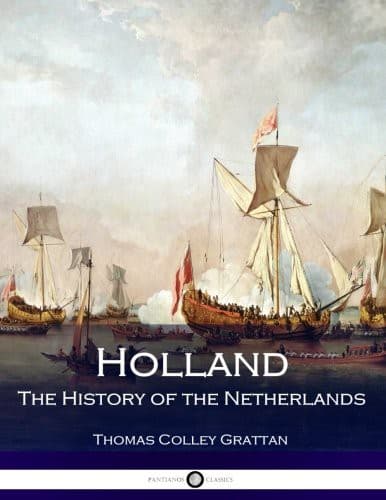
Holland: The History of the NetherlandsGrattan, Thomas Colley
History
Holland: The History of the Netherlands
Grattan, Thomas Colley
Netherlands -- History
The following year was distinguished by another daring attempt on
the part of the Hollanders, but followed by a different result.
A captain named Haranguer concerted with one Adrien Vandenberg
a plan for the surprise of Breda, on the possession of which
Prince Maurice had set a great value. The associates contrived
to conceal in a boat laden with turf (which formed the principal
fuel of the inhabitants of that part of the country), and of
which Vandenberg was master, eighty determined soldiers, and
succeeded in arriving close to the city without any suspicion
being excited. One of the soldiers, named Matthew Helt, being
suddenly afflicted with a violent cough, implored his comrades
to put him to death, to avoid the risk of a discovery. But a
corporal of the city guard having inspected the cargo with
unsuspecting carelessness, the immolation of the brave soldier
became unnecessary, and the boat was dragged into the basin by
the assistance of some of the very garrison who were so soon to
fall victims to the stratagem. At midnight the concealed soldiers
quitted their hiding-places, leaped on shore, killed the sentinels,
and easily became masters of the citadel. Prince Maurice, following
close with his army, soon forced the town to submit, and put it
into so good a state of defence that Count Mansfield, who was
sent to retake it, was obliged to retreat after useless efforts
to fulfil his mission.
The duke of Parma, whose constitution was severely injured by
the constant fatigues of war and the anxieties attending on the
late transactions, had snatched a short interval for the purpose
of recruiting his health at the waters of Spa. While at that place
he received urgent orders from Philip to abandon for a while all
his proceedings in the Netherlands, and to hasten into France
with his whole disposable force, to assist the army of the League.
The battle of Yvri (in which the son of the unfortunate Count
Egmont met his death while fighting in the service of his father's
royal murderer) had raised the prospects and hopes of Henry IV.
to a high pitch; and Paris, which he closely besieged, was on
the point of yielding to his arms. The duke of Parma received his
uncle's orders with great repugnance; and lamented the necessity
of leaving the field of his former exploits open to the enterprise
and talents of Prince Maurice. He nevertheless obeyed; and leaving
Count Mansfield at the head of the government, he conducted his
troops against the royal opponent, who alone seemed fully worthy
of coping with him.
Public-domain text, read in full here on John Shaqi.
Reviews
Reviews
No reviews yet
Be the first to share your thoughts on this work.
Elsewhere in the archive
Join the Discussion
Join the discussion
Sign in to leave a comment or review.
Sign InorCreate an account