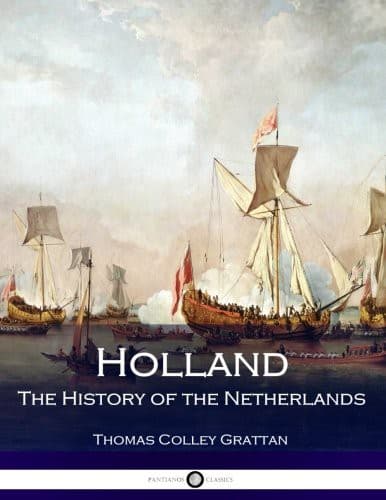
Holland: The History of the NetherlandsGrattan, Thomas Colley
History
Holland: The History of the Netherlands
Grattan, Thomas Colley
Netherlands -- History
Scarcely a vestige of the place remained
beyond those terrible evidences of destruction. Its ditches,
filled up with the rubbish of ramparts, bastions, and redoubts,
left no distinct line of separation between the operations of
its attack and its defence. It resembled rather a vast sepulchre
than a ruined town, a mountain of earth and rubbish, without a
single house in which the wretched remnant of the inhabitants
could hide their heads--a monument of desolation on which victory
might have sat and wept.
During the progress of this memorable siege Queen Elizabeth of
England had died, after a long and, it must be pronounced, a
glorious reign; though the glory belongs rather to the nation
than to the monarch, whose memory is marked with indelible stains
of private cruelty, as in the cases of Essex and Mary Queen of
Scots, and of public wrongs, as in that of her whole system of
tyranny in Ireland. With respect to the United Provinces she was
a harsh protectress and a capricious ally. She in turns advised
them to remain faithful to the old impurities of religion and to
their intolerable king; refused to incorporate them with her
own states; and then used her best efforts for subjecting them to
her sway. She seemed to take pleasure in the uncertainty to which
she reduced them, by constant demands for payment of her loans,
and threats of making peace with Spain. Thus the states-general
were not much affected by the news of her death; and so rejoiced
were they at the accession of James I. to the throne of England
that all the bells of Holland rang out merry peals; bonfires
were set blazing all over the country; a letter of congratulation
was despatched to the new monarch; and it was speedily followed
by a solemn embassy composed of Prince Frederick Henry, the grand
pensionary De Barneveldt, and others of the first dignitaries of
the republic. These ambassadors were grievously disappointed at
the reception given to them by James, who treated them as little
better than rebels to their lawful king. But this first disposition
to contempt and insult was soon overcome by the united talents
of Barneveldt and the great duke of Sully, who were at the same
period ambassadors from France at the English court. The result
of the negotiations was an agreement between those two powers to
take the republic under their protection, and use their best
efforts for obtaining the recognition of its independence by
Spain.
The states-general considered themselves amply recompensed for
the loss of Ostend by the taking of Ecluse, Rhinberg, and Grave,
all of which had in the interval surrendered to Prince Maurice;
but they were seriously alarmed on finding themselves abandoned
by King James, who concluded a separate peace with Philip III.
of Spain in the month of August this year.
Public-domain text, read in full here on John Shaqi.
Reviews
Reviews
No reviews yet
Be the first to share your thoughts on this work.
Elsewhere in the archive
Join the Discussion
Join the discussion
Sign in to leave a comment or review.
Sign InorCreate an account