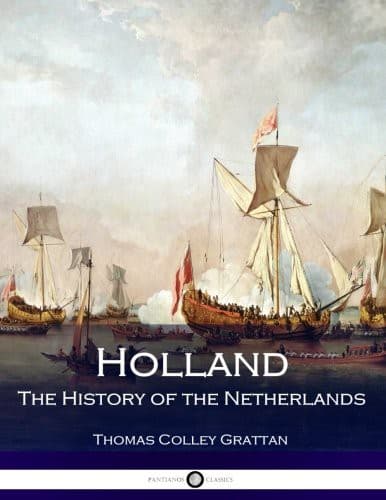
Holland: The History of the NetherlandsGrattan, Thomas Colley
History
Holland: The History of the Netherlands
Grattan, Thomas Colley
Netherlands -- History
gave way, and had been completely defeated, had not Spinola put
in practice an old and generally successful stratagem. He caused
almost all the drums of his army to beat in one direction, so
as to give the impression that a still larger reinforcement was
approaching. Maurice, apprehensive that the former panic might
find a parallel in a fresh one, prudently ordered a retreat, which
he was able to effect in good order, in preference to risking the
total disorganization of his troops. The loss on each side was
nearly the same; but the glory of this hard-fought day remained
on the side of Spinola, who proved himself a worthy successor of
the great duke of Parma, and an antagonist with whom Maurice
might contend without dishonor.
The naval transactions of this year restored the balance which
Spinola's successes had begun to turn in favor of the royalist
cause. A squadron of ships, commanded by Hautain, admiral of
Zealand, attacked a superior force of Spanish vessels close to
Dover, and defeated them with considerable loss. But the victory
was sullied by an act of great barbarity. All the soldiers found
on board the captured ships were tied two and two and mercilessly
flung into the sea. Some contrived to extricate themselves, and
gained the shore by swimming; others were picked up by the English
boats, whose crews witnessed the scene and hastened to their
relief. The generous British seamen could not remain neuter in
such a moment, nor repress their indignation against those whom
they had hitherto so long considered as friends. The Dutch vessels
pursuing those of Spain which fled into Dover harbor, were fired
on by the cannon of the castle and forced to give up the chase.
The English loudly complained that the Dutch had on this occasion
violated their territory; and this transaction laid the foundation
of the quarrel which subsequently broke out between England and
the republic, and which the jealousies of rival merchants in
either state unceasingly fomented. In this year also the Dutch
succeeded in capturing the chief of the Dunkirk privateers, which
had so long annoyed their trade; and they cruelly ordered sixty
of the prisoners to be put to death. But the people, more humane
than the authorities, rescued them from the executioners and
set them free.
Public-domain text, read in full here on John Shaqi.
Reviews
Reviews
No reviews yet
Be the first to share your thoughts on this work.
Elsewhere in the archive
Join the Discussion
Join the discussion
Sign in to leave a comment or review.
Sign InorCreate an account